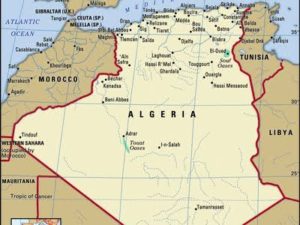
Algeria is located in North Africa on the Mediterranean coast. It is bordered by Tunisia to the northeast, Libya to the east, Niger to the southeast, Mali and Mauritania to the southwest, Western Sahara to the west, and Morocco to the northwest. It is the largest country in Africa by land area. Over 80 percent of the country is covered by the Sahara Desert, while the northern region along the coast features fertile plains and the Tell Atlas mountain range.
People & Culture
The majority of the population is Arab-Berber, with the native Berber (Amazigh) people having inhabited the region for thousands of years. Arabic and Tamazight are the official languages, and French is widely spoken in business and education.
Islam is the official religion and plays a central role in daily life. Algerian culture blends Arab, Berber, Mediterranean, and French influences. Rai music, originating in the western city of Oran, is a globally recognized musical genre. Favorite national dishes include couscous served with vegetables and meat, along with traditional flatbreads and pastries like baklava.
Nature
Algeria’s geography ranges from the Mediterranean coastline to the vast sands and sandstone plateaus of the Sahara Desert. The Ahaggar (Hoggar) Mountains in the south feature dramatic volcanic peaks and high-altitude desert ecosystems.
The country is home to diverse wildlife, including the fennec fox (the national animal), Barbary macaques, desert gazelles, and cheetahs in the far south. Tassili n’Ajjer National Park is a major protected area known for its unique sandstone formations and ancient prehistoric cave art.
Government
Algeria is a semi-presidential republic. Executive power is exercised by the President, who serves as head of state, and the Prime Minister, who serves as head of government. Parliament is bicameral, consisting of the People’s National Assembly and the Council of the Nation.
History
The region was anciently inhabited by Berbers and later controlled by the Carthaginians, Romans, and Byzantines. In the 7th century, Arab conquests brought Islam and the Arabic language to the area. Algeria later became a autonomous province within the Ottoman Empire.
In 1830, France invaded Algeria and colonization began, lasting for over a century. A brutal war of independence against French rule broke out in 1954, led by the National Liberation Front (FLN). Algeria officially gained independence in 1962. During the 1990s, the country endured a decade-long civil war known as the “Black Decade.” In recent years, Algeria has focused on political stability, infrastructure development, and economic diversification.