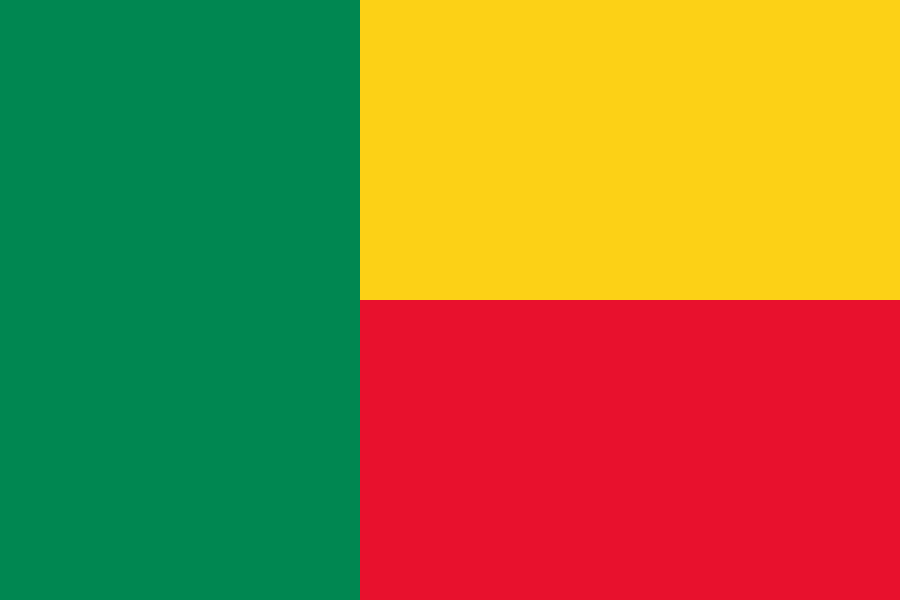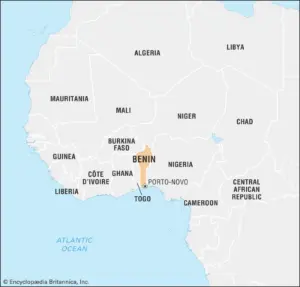
A country in West Africa, formerly known as Dahomey. It is a nation with a deep history of kingdoms and living traditions. Located on the Gulf of Guinea, Benin is bordered by Togo to the west, Nigeria to the east, Burkina Faso and Niger to the north, and the Atlantic Ocean to the south. Despite its small size, Benin holds a unique place in African history as the cradle of the powerful Kingdom of Dahomey and the birthplace of Vodun, a traditional religion that has spread far beyond its borders. The country is also widely regarded as one of the pioneers of democratic transition in Africa, having held its first free elections in 1991 after decades of political turbulence.
History
Benin is the heir to the ancient Kingdom of Dahomey, one of the most organized powers in West Africa, with its capital at Abomey. From the 15th century onward, the kingdom prospered largely through the transatlantic slave trade. In 1894, after armed resistance led by the last king, Behanzin, France conquered the entire territory and established the colony of Dahomey. The country gained independence on August 1, 1960. After independence, it experienced more than a decade of coups and instability, earning the nickname “the sick man of Africa.” In 1972, Mathieu Kérékou took power, adopting socialism and a one-party system, and in 1975 renamed the country the “People’s Republic of Benin.” In 1990, a national conference launched democratization, and in 1991 the first free elections were held, making Benin an early example of democratic transition in Africa. In April 2026, Romuald Wadagni was elected as the new president.
Culture
Benin is the birthplace of Vodun (voodoo), a traditional religion that deeply influences social life, with Ouidah as its spiritual center, home to the “Door of No Return” and other memorials of the slave trade. More than 55 languages are spoken, with French as the official language and Fon, Yoruba, and Bariba widely used. About 53% of the population is Christian, 24% Muslim, and 18% followers of traditional religions. In terms of cultural heritage, the Royal Palaces of Abomey (UNESCO World Heritage Site) and the Gèlèdè mask dance (UNESCO Intangible Cultural Heritage) are the most representative.
Nature
Benin has an elongated north-south shape, covering 112,622 km², with a short coastline of just 121 km on the Gulf of Guinea. The terrain is generally flat, rising from sandy coastal plains in the south to central plateaus at 200–400 meters, with the Atakora Mountains in the northwest acting as a “water tower”; the highest point, Mount A légéjo, is about 658 meters. The south has an equatorial climate with two rainy and two dry seasons; the north is tropical with one rainy and one dry season, the latter influenced by the dry Harmattan wind. Major rivers include the Ouémé, Mono, and Couffo, all flowing south to the sea; the Niger River system lies in the northeast. Pendjari National Park, part of the W-Arly-Pendjari complex, is one of West Africa’s most important wildlife reserves.
Government
Benin is a presidential republic. The President is head of state, head of government, and commander-in-chief of the armed forces, elected by direct universal suffrage. Under a constitutional amendment passed in December 2025, from 2026 the presidential and parliamentary terms were extended from 5 to 7 years, and a bicameral parliament was formally established with a new Senate sharing legislative power with the National Assembly. The National Assembly currently has 109 members, elected in January 2026. The current president is Romuald Wadagni, elected in April 2026 and inaugurated in May.