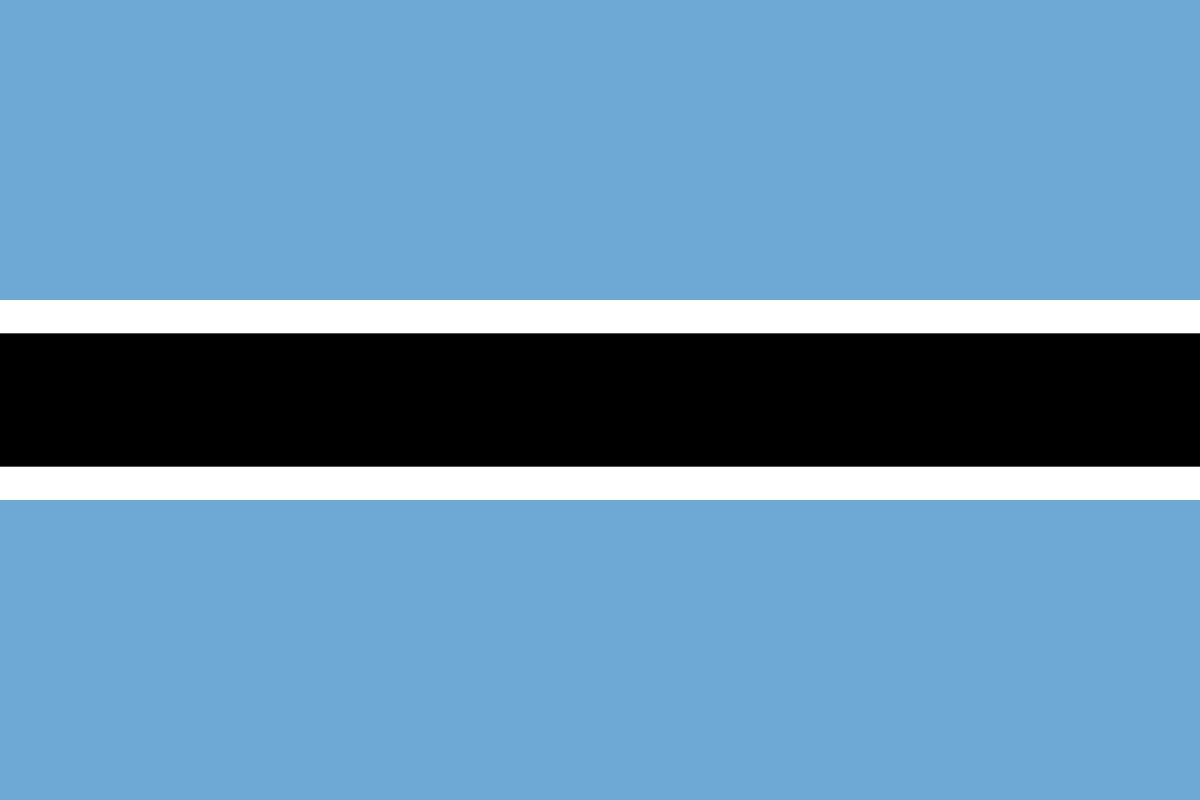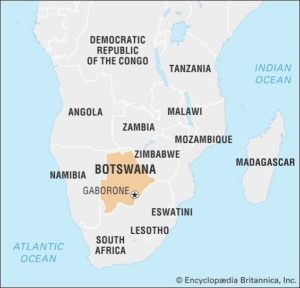
A landlocked country in Southern Africa, bordered by South Africa to the south and southeast, Namibia to the west and north, Zambia to the north, and Zimbabwe to the northeast. Formerly known as the Bechuanaland Protectorate, Botswana is one of Africa’s most remarkable success stories: a nation that transformed itself from one of the world’s poorest countries at independence in 1966 into a stable, upper-middle-income economy driven by diamond wealth, good governance, and prudent resource management. It is also widely praised for its commitment to environmental conservation and its peaceful, democratic political culture.
History
The area now known as Botswana has been inhabited since the Stone Age, with archaeological evidence of human settlement dating back tens of thousands of years. The ancestors of today’s Batswana (the collective name for the people of Botswana) migrated into the region from the 14th century onward, establishing several ethnic chiefdoms that shared a common language and history. In the late 19th century, facing pressure from Boer settlers from the Transvaal and German expansion from Namibia, three Tswana chiefs—Khama III, Sebele I, and Bathoen I—traveled to Britain in 1895 to lobby for protection. Their efforts succeeded, and the Bechuanaland Protectorate was established under British administration. After 80 years as a protectorate, Bechuanaland attained self-government in 1965 and became the independent Republic of Botswana on September 30, 1966. Sir Seretse Khama, a hereditary chief of the Bamangwato, was elected as the first president and led the country until his death in 1980. The Botswana Democratic Party (BDP) dominated politics for nearly six decades, but in 2024, the opposition Umbrella for Democratic Change (UDC) won the elections, and Duma Boko became the country’s sixth president—the first transfer of power to an opposition party since independence
Culture
Botswana’s culture is shaped by a strong sense of national identity and traditional values. The country is home to more than 20 ethnic groups and over 30 languages, though the dominant culture is that of the Batswana (Tswana people), whose language, Setswana, is the national language. Traditional social structures remain important: the kgotla, a customary assembly place where community matters are discussed with respect and consensus, is a cornerstone of local governance and social life. Respect for elders, religious observance, and traditional gender roles are widely upheld. The House of Chiefs serves as an advisory body on traditional matters. Notable cultural expressions include the colorful baskets woven by women in the Etsha and Gumare villages of the north, and pottery from Thamaga in the southwest. The Kalahari Desert is home to some of the oldest rock paintings in Southern Africa, with geometric and animal figures dating back 20,000 years. The San (Basarwa) peoples, among the oldest inhabitants of the region, maintain distinct cultural traditions, including the tsutsube dance, though the commercialization and nationalization of these practices through competitions has raised complex questions about cultural ownership.
Nature
Botswana’s geography is defined by the Kalahari Desert, which covers about two-thirds of the country’s territory. Despite its arid reputation, the country is home to one of the world’s most remarkable wetlands: the Okavango Delta, an inland river delta that spreads across approximately 12,000 km² in the northwest, supporting an extraordinary diversity of wildlife and bird species. All rivers in Botswana are seasonal except for the Okavango and Linyanti/Chobe rivers in the north. The Chobe National Park and Savuti Reserve are renowned for their large elephant populations—Botswana is home to over 200,000 elephants, the largest population in the world. Other major protected areas include the Makgadikgadi Pans National Park, the Nxai Pan National Park, and the Nata Bird Sanctuary, a Ramsar-designated site known for its flamingos. The Tsodilo Hills, a UNESCO World Heritage Site, are famous for their ancient rock paintings. Botswana is also a major producer of soda ash and salt from the Sowa Pan, one of the few natural deposits of these minerals in the world. Environmental conservation is a national priority, enshrined in the National Conservation Strategy.
Government
Botswana is a presidential republic with a parliamentary democracy. The President serves as both head of state and head of government, and is elected by the National Assembly for a five-year term. The National Assembly is the primary legislative body, with 57 members directly elected by universal suffrage, plus additional indirectly elected and co-opted members. The House of Chiefs is an advisory body that provides counsel on traditional and constitutional matters, particularly those affecting customary law and tribal affairs, but it does not hold legislative power. The judiciary is independent and combines Roman-Dutch civil law and English common law, with customary courts operating alongside formal courts in rural areas. Suffrage is universal at age 18, and elections are held every five years. Botswana is consistently recognized by Transparency International as having one of the least corrupt systems in Africa. The current president is Duma Boko, who took office in November 2024 following the UDC’s historic electoral victory.