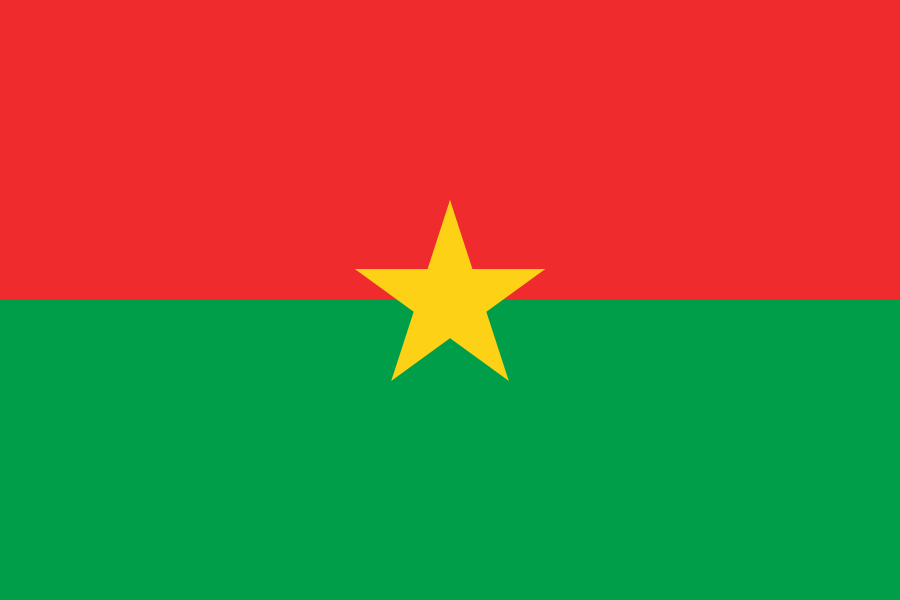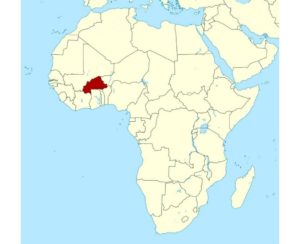
A landlocked country in West Africa, formerly known as Upper Volta. Located in the heart of the Sahel region, Burkina Faso is a nation of remarkable cultural diversity, home to more than 60 ethnic groups whose traditions coexist with unusual harmony. The country’s name, adopted in 1984, translates from local languages as “Land of Incorruptible Men,” reflecting the revolutionary ideals of the era. Despite persistent political instability and significant developmental challenges, Burkina Faso has earned international recognition for its vibrant cultural scene, including FESPACO, the largest African film festival on the continent.
History
The territory was inhabited by the Mossi people from the 11th century, who established powerful kingdoms that resisted external conquest for centuries. France created the colony of Upper Volta in 1919, dissolved it in 1932, and reconstituted it in 1947. The country gained full independence on August 5, 1960, with Maurice Yaméogo as its first president. Since then, Burkina Faso has experienced numerous coups and periods of military rule. Captain Thomas Sankara seized power in 1983 and renamed the country Burkina Faso in 1984, but was overthrown and killed in 1987 by Blaise Compaoré, who ruled for 27 years until mass protests forced him from power in 2014. After a brief transition, Roch Marc Christian Kaboré was elected in 2015 and re-elected in 2020, but was ousted in a coup in January 2022. Captain Ibrahim Traoré took power in September 2022 and remains the transitional president.
Culture
Burkina Faso’s population is composed of more than 60 ethnic groups, with the Mossi being the largest at roughly 50% of the population. Other significant groups include the Fulani, Gurunsi, Senufo, Lobi, Bobo, and Mande. French is the official language, but more than 60 languages are spoken, including Mooré, Dioula, Fulfulde, and Gulmancéma. Islam is the predominant religion, followed by indigenous beliefs and Christianity. The country is renowned for its cultural festivals: FESPACO (Pan-African Film and Television Festival of Ouagadougou), held biennially in odd years, is the largest African film festival on the continent, while SIAO (International Craft Fair of Ouagadougou) showcases African craftsmanship. Faso Dan Fani, a traditional hand-woven cloth, is a prized national textile. Traditional art forms include elaborate masks, bronze casting, and music.
Nature
Burkina Faso covers 274,200 km² and is entirely landlocked, located more than 500 km from the Gulf of Guinea. The landscape is dominated by a vast, gently undulating peneplain of Precambrian granite, with an average altitude of 300-350 meters. The highest point, Tenakourou, reaches 749 meters in the southwest. The climate is Sudano-Sahelian, characterized by a dry season from November to May, when the Harmattan wind blows from the Sahara, and a rainy season from June to October. Rainfall ranges from over 1,000 mm in the southwest to less than 350 mm in the far north. Three major river systems traverse the country: the Volta (Black, White, and Red), the Comoé, and the Niger, though none are navigable. Wildlife includes 35 species of large mammals and approximately 120 species of fish. Environmental pressures include desertification, overgrazing, and deforestation.
Government
Burkina Faso is officially a presidential republic, though since 2022 it has been governed under a transitional charter following military coups. The President serves as head of state, head of government, and commander-in-chief of the armed forces. The current transitional president is Captain Ibrahim Traoré, who took power in September 2022. The Transitional Parliament (Assemblée législative de transition) has 71 members. The 1991 constitution was suspended following the 2022 coup, and a Transitional Charter governs the country, with a Revolutionary Charter adopted in March 2026. Suffrage is universal from age 18. In January 2026, the government announced the dissolution of political parties and political groups.