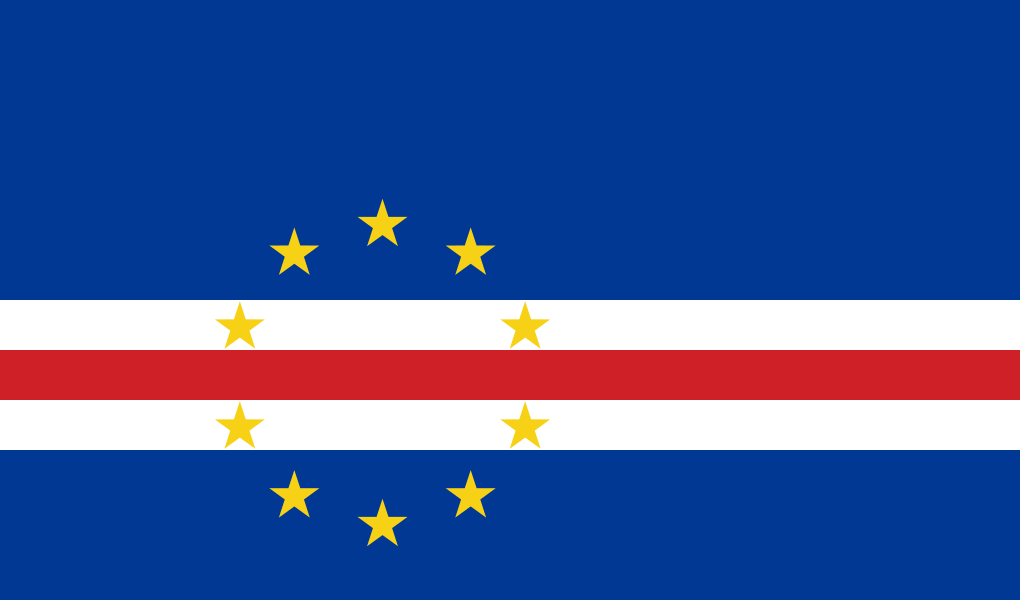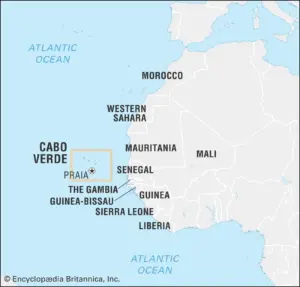
An archipelago nation of volcanic origin located in the Atlantic Ocean, approximately 570 kilometers off the west coast of Africa. Cabo Verde is a country defined by its unique creole culture, born from the fusion of Portuguese colonizers and enslaved Africans, and by its remarkable political stability. Often described as a “small nation with a big story,” it has transitioned from a resource-poor, drought-prone colony into one of Africa’s most stable democracies and prosperous economies. The country’s essence is captured by the word “morabeza”—a Creole term meaning warmth, hospitality, and a gentle way of life.
History
The islands were uninhabited when Portuguese navigators first arrived in 1456 (or 1460, according to some sources). Portuguese colonization began in 1462 on the island of Santiago. Due to its strategic location between Europe, Africa, and the Americas, the archipelago became a crucial transshipment point for the transatlantic slave trade from the 16th to the 19th centuries. The mixing of European settlers and enslaved Africans gave rise to the Cabo Verdean people and the Crioulo (Creole) language.
Following centuries of Portuguese rule, the African Party for the Independence of Guinea and Cabo Verde (PAIGC) was founded in 1956 by Amílcar Cabral, a pivotal figure in the anti-colonial struggle. After the Carnation Revolution in Portugal, an agreement was signed in 1974, and Cabo Verde achieved independence on July 5, 1975. The country initially moved toward unity with Guinea-Bissau, but abandoned that plan in 1980. A new constitution in 1992 established a multi-party democracy, ending one-party rule and ushering in an era of political stability.
Culture
Cabo Verdean culture is a genuine hybrid of African and European influences. The official language is Portuguese, but the heart of the nation beats in Cabo Verdean Creole (Kriolu), spoken by virtually everyone and considered the true national language and a “cultural flag”. The vast majority of the population is Catholic (over 90%), though Protestant denominations are also present.
Music is central to the national identity, with several distinct genres:
Morna: The most iconic genre, often melancholic and lyrical, associated with the legendary singer Cesária Évora. It expresses themes of longing and “sodade” (nostalgia).
Coladeira: An upbeat, rhythmic genre for dancing, often satirical or festive. Funáná and Batuque: More African-rooted rhythms, traditionally played with accordion and percussion, respectively.
Cuisine is centered around maize (corn) and beans. The national dish is Cachupa, a slow-cooked stew of corn, beans, and vegetables, sometimes with meat or fish. It is a symbol of family and togetherness. Other staples include fish stews and dishes made with cassava and sweet potato.
Nature
Cabo Verde is an archipelago of 10 islands and 5 islets, divided into two groups: the Barlavento (windward) islands in the north and the Sotavento (leeward) islands in the south. The total land area is just 4,033 km². All islands are of volcanic origin.
Geography: The terrain varies significantly. The islands of Sal, Boavista, and Maio are relatively flat, sandy, and arid. The more mountainous islands, such as Santo Antão, Santiago, and Fogo, are rugged and deeply eroded. Pico do Fogo on Fogo Island is the highest point at 2,829 meters (or 2,882 m, depending on the source) and is an active volcano that last erupted in 2014.
Climate: The climate is dry and hot, with a pronounced dry season and scarce, irregular rainfall. The islands are influenced by the Harmattan winds from the Sahara.
Flora and Fauna: The biodiversity is unique but fragile, with a high number of endemic species. The dragon tree (dragoeiro) is a notable endemic plant that predates human settlement. The grey long-eared bat is the only endemic mammal. The islands are an important nesting site for seabirds and a haven for marine life, including turtles and whales.
Government
Cabo Verde is a parliamentary republic with a semi-presidential system. The political landscape is highly stable, and the country consistently ranks as Africa’s most democratic nation according to Freedom House.
Executive: Power is shared between a directly elected President (head of state, commander-in-chief, and mediator) and a Prime Minister (head of government, chosen by the parliament). Currently, the President is José Maria Neves (from the PAICV party), and the Prime Minister is Ulisses Correia e Silva (from the MpD party).
Legislative: The National Assembly is a unicameral body with 72 members elected by proportional representation for five-year terms.
Judiciary: The judiciary is independent, with a Supreme Court of Justice as the highest court.
Political Parties: The two dominant parties, the MpD (Movement for Democracy) and the PAICV (African Party for the Independence of Cabo Verde), have peacefully alternated power since 1991.