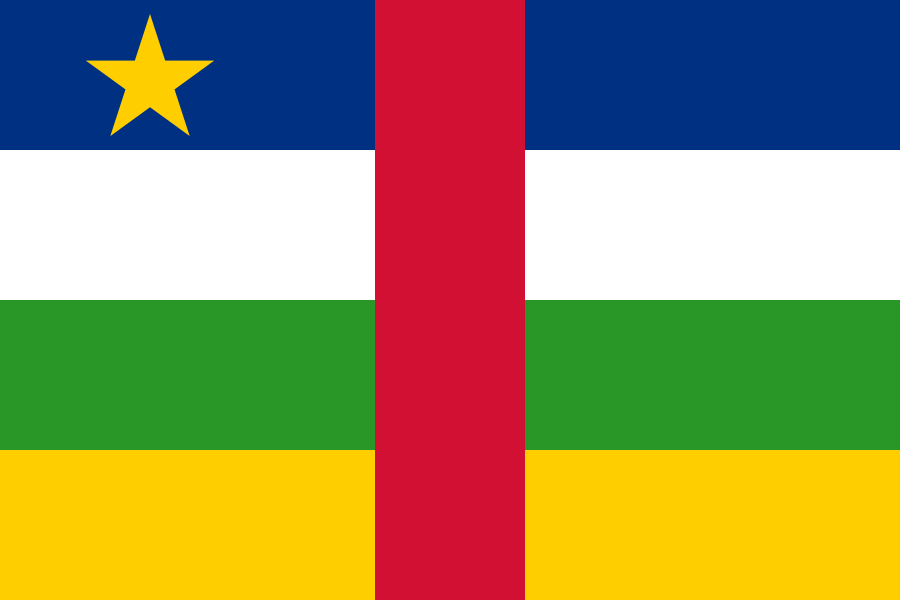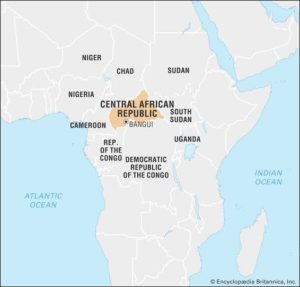
A landlocked country located in the heart of the African continent, formerly known as the French colony of Ubangi-Shari. Despite its abundant natural resources—including diamonds, gold, and vast forests—the CAR remains one of the world’s least developed nations, scarred by decades of political instability, coups, and armed conflict. Since independence in 1960, the country has experienced only brief periods of democratic governance, punctuated by military takeovers and, in recent years, severe sectarian violence between Muslim and Christian communities.
History
The territory that became the Central African Republic was inhabited by various ethnic groups for centuries before French colonization. France established the colony of Ubangi-Shari in 1894. In 1958, Barthélemy Boganda, a charismatic leader and priest considered the father of the nation, proclaimed the Central African Republic as an autonomous territory within the French Community. Boganda died in a mysterious plane crash in 1959, and the country achieved full independence on August 13, 1960, under his successor, David Dacko . In 1965, Dacko was overthrown by Jean-Bédel Bokassa, who declared himself Emperor in 1977 and ruled with brutality until his overthrow in 1979 . Subsequent decades saw a series of coups and unstable governments, including the rise of Ange-Félix Patassé in 1993 . In 2013, a coalition of mostly Muslim rebels known as Séléka seized power, sparking a violent backlash from Christian militias called anti-balaka, leading to widespread sectarian conflict . Elections in 2016 brought Faustin-Archange Touadéra to the presidency, but armed groups continue to control large portions of the country.
Culture
The CAR is home to more than 60 ethnic groups, with the Baya being the largest and the Banda the most widely distributed . Other significant groups include the Sara, Yakoma, and Baka (Pygmy) peoples . The official languages are French and Sango, a Ngbandi-based creole that serves as the lingua franca . Religion is a complex blend of Christianity, Islam, and traditional animist beliefs. Christians (Catholic and Protestant combined) make up roughly 50-80% of the population, depending on the source, while Muslims represent about 15%, concentrated primarily in the north and northeast . Traditional beliefs in ancestral spirits and witchcraft remain influential, often intertwined with Christian or Muslim practice . The country’s cultural heritage includes rich traditions of oral storytelling, music, and mask-making, though decades of conflict have disrupted cultural life.
Nature
The CAR covers an area of 623,000 km² and is bordered by Chad, Sudan, South Sudan, the Democratic Republic of the Congo, the Republic of the Congo, and Cameroon . The landscape consists of rolling plateaus in the center and south, with the Fertit Mountains in the northeast and the Yadé Massif in the northwest; the highest point is Mount Ngaoui (1,420 m) . Three climate zones dominate: equatorial in the south, intertropical in the center, and Sahelian in the north, with a rainy season from May to October and a dry season from November to April . The country is drained by two major river systems: the Shari and its tributaries flowing north toward Lake Chad, and the Ubangi flowing south toward the Congo River . The CAR is renowned for its biodiversity, particularly its forest elephants and western lowland gorillas, which are protected in the Dzanga-Sangha Special Reserve in the southwest . Other significant protected areas include Manovo-Gounda St. Floris National Park (a UNESCO World Heritage Site in danger) and Bamingui-Bangoran National Park in the north .
Government
The CAR is a presidential republic. The current constitution, adopted by referendum in 2023, established a 7-year presidential term and removed term limits . The President serves as head of state and head of government, with a Prime Minister appointed by the president . The National Assembly is unicameral, with 140 members directly elected for 5-year terms . The judiciary includes a Supreme Court and a Constitutional Court, whose judges are appointed by various high-level officials and serve non-renewable terms . The country is divided into 7 regions and 17 prefectures . The current president is Faustin-Archange Touadéra, re-elected in December 2025 with 76.2% of the vote .