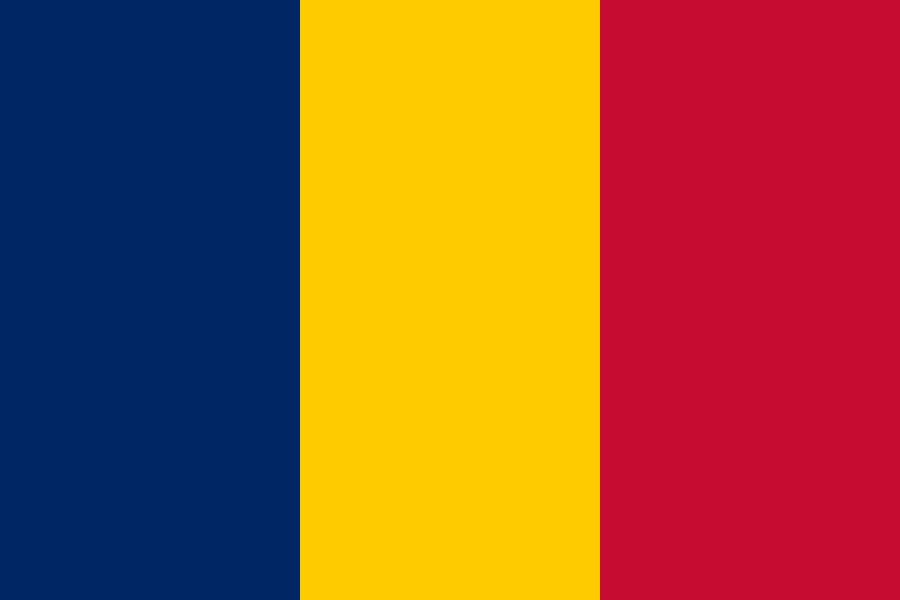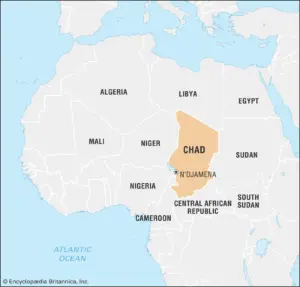
A landlocked country in north-central Africa, often described as a crossroads between the Arab world and sub-Saharan Africa. Chad is the fifth-largest country in Africa by area, stretching from the arid Sahara Desert in the north to fertile savannas in the south. Despite its vast territory and natural resources—including oil, gold, and uranium—Chad remains one of the world’s least developed nations. Its post-independence history has been marked by persistent political instability, civil conflict, and tensions between its Muslim-majority north and Christian-animist south. The country is also a key host to refugees fleeing conflicts in neighboring Sudan and the Central African Republic.
History
The area around Lake Chad has been inhabited since at least 500 BC. The Sao civilization flourished in the south from the 10th century, leaving behind terracotta and bronze artifacts. By the 16th century, three rival kingdoms dominated the region: Kanem-Bornu, Baguirmi, and Ouaddaï . In the late 19th century, the Sudanese conqueror Rabah al-Zubayr subdued all three kingdoms until French forces defeated and killed him in 1900 . Chad became part of French Equatorial Africa, achieving full independence on August 11, 1960, under President François Tombalbaye .
Tombalbaye was killed in a 1975 coup, beginning decades of instability. Hissène Habré seized power in 1982 and ruled until Idriss Déby Itno overthrew him in 1990 . Déby ruled for three decades until his death in April 2021 during a battle with rebels. His son, Mahamat Idriss Déby Itno, took power leading a Transitional Military Council, and was declared winner of the May 2024 presidential election, extending the Déby family’s rule .
Culture
Chad is home to more than 200 ethnic groups, divided largely along geographic lines: Arab and nomadic groups in the Muslim north, Sara and other sedentary peoples in the Christian-animist south, and a mix in the central Sahel . The official languages are French and Arabic, though over 100 local languages and dialects are spoken. Islam is the majority religion, followed by Christianity, with about 10% of the population practicing exclusively indigenous beliefs .
Traditional social structures are conservative, with family as the foundation. Greetings are formal, and respect for elders and hierarchy is paramount . Traditional music features drums, flutes, and string instruments. The diet varies by region: millet porridge is widely consumed, while southerners eat more rice, beans, and agricultural products, and northern nomads rely on milk, meat, and fish .
Nature
Chad covers 1,284,000 km² and is divided into three major geographic zones: the Sahara Desert in the north (less than 200 mm rainfall annually), the Sahelian belt in the center (200–600 mm), and the fertile Sudanese savanna in the south (600–1,200 mm) . The highest point is Emi Koussi (3,415 m) in the Tibesti Mountains . Major rivers include the Chari and Logone, which flow into Lake Chad, a critical water source that has shrunk dramatically due to droughts .
Chad has 10 protected areas covering about 10.2% of its territory, including 3 national parks and 7 faunal reserves . Zakouma National Park is renowned for its elephant population, though poaching has severely reduced numbers . Other notable reserves include Siniaka Minia and the transboundary BSB Yamoussa complex, home to the world’s largest population of Derby eland . Northern reserves protect endangered species like the addax and oryx .
Government
Chad is a presidential republic with a unitary structure. The President is head of state and government, directly elected for a 6-year term . Mahamat Idriss Déby Itno has been president since April 2021, legitimized by the disputed 2024 election . The Prime Minister, Allamaye Halina, was appointed in May 2024 .
The legislature is bicameral: a National Assembly with 188 members and a Senate with 69 members (two-thirds indirectly elected, one-third appointed by the president) . The ruling Patriotic Salvation Movement (MPS) dominates politics. The judiciary includes a Supreme Court at the top of the hierarchy, with courts of appeal, criminal courts, and customary assessors in civil matters . The voting age is 18 . Civic space is heavily restricted, with authorities frequently blocking assemblies and suppressing dissent .