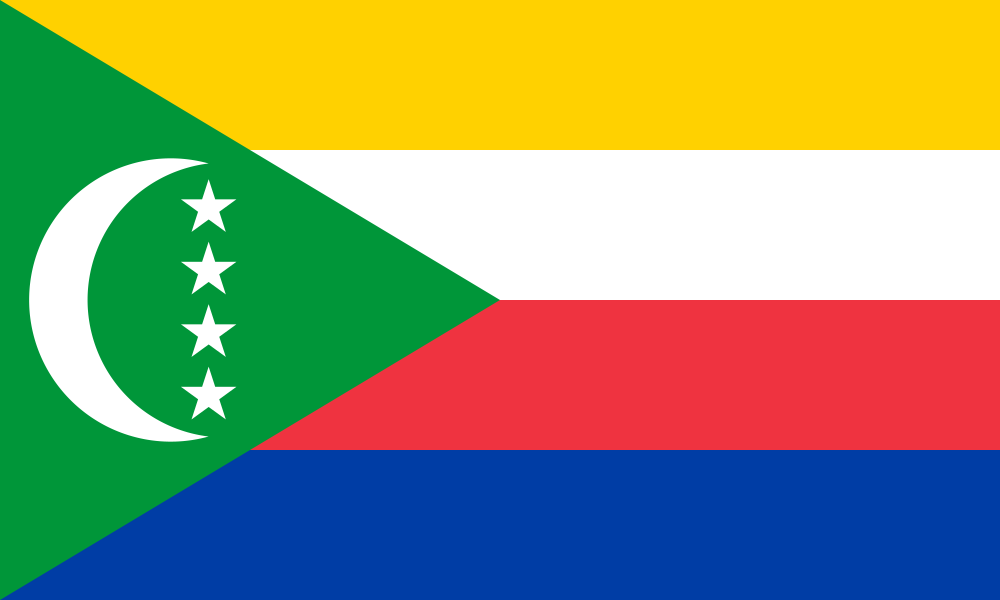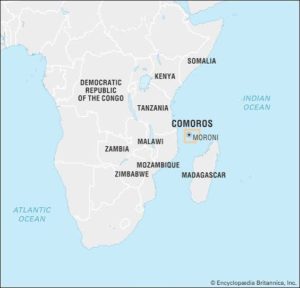
An archipelago nation in the Indian Ocean, situated at the northern end of the Mozambique Channel between Madagascar and the southeastern coast of Africa. Known as the “Perfume Islands” for its production of ylang-ylang, vanilla, and cloves, the Comoros is a country of volcanic origin with a rich Swahili-Arab heritage. Despite its small size, it is one of the world’s largest producers of ylang-ylang essence. The country has a history marked by political instability—more than twenty coups since independence—but remains a vibrant, culturally distinct nation with a largely peaceful population.
History
The islands were first settled in the 9th century by Bantu-speaking peoples from the Mozambique-Tanzania region, followed by Arab and Persian traders who established sultanates along the coast . By the 16th century, the Comoros had become a key stopover on the Portuguese route to India, later attracting English, German, and French interest. France established a protectorate in 1886 and formally annexed the islands in 1912, administering them as a dependency of Madagascar until 1946 .
The country declared independence on July 6, 1975, as the State of the Comoros, under President Ahmed Abdallah . However, the island of Mayotte voted to remain French and is still administered by France today, a source of ongoing tension . Since independence, the Comoros has experienced more than twenty coups and attempted coups, including a radical revolutionary period and a mercenary regime . The current constitution, adopted in 2018, restructured the presidency and extended term limits . Azali Assoumani has served as president since 2016 and was re-elected in 2024 .
Culture
Comorian culture is a unique blend of Swahili, African, Arab, and French influences, reflected in its language, religion, and social customs . The population is almost entirely Muslim of the Shafi’i rite, and Islam permeates daily life . The official languages are Comorian (a Bantu language with dialectal variations across islands), Arabic, and French .
The family is the foundation of Comorian society, which has matriarchal elements—women legally hold authority in the family and transmit their names to children . The “Grand Mariage” (Anda) is a central tradition, especially on Grande Comore. It is an elaborate, week-long celebration that represents a lifetime of savings and confers social status as a “grand notable” . Traditional arts include wood carving, pottery, basketry, and embroidery, with women playing a central role . The cuisine features dishes such as ypègna and pilaou, reflecting the islands’ diverse influences .
Nature
The Comoros covers 1,862 km² and consists of three main islands: Grande Comore (Ngazidja), Anjouan (Nzwani), and Mohéli (Mwahi), plus numerous islets . All islands are of volcanic origin, with mountainous terrain. Mount Karthala (2,361 m) on Grande Comore is one of the world’s most active volcanoes, having erupted more than twenty times since the 19th century .
The country has three Ramsar wetlands of international importance: Lake Dziani Boundouni (a crater lake), Mount Karthala (with dense humid forest and five endemic endangered bird species), and Mount Ntringui on Anjouan (habitat of the critically endangered Livingstone’s flying fox) . Mohéli National Park and the Mwali Biosphere Reserve protect exceptional marine and terrestrial biodiversity, including nesting sites for green turtles, breeding grounds for humpback whales, and refuges for dugongs . The Comoros is recognized as an Endemic Bird Area of critical priority, with up to 34 endemic bird species.
Government
The Comoros is a federal presidential republic. The President serves as both head of state and head of government, elected by direct universal suffrage for a 5-year term . Under the 2018 constitution, the presidency rotates among the three islands, and the current president is Azali Assoumani, re-elected in January 2024 .
The legislature is unicameral: the Assembly of the Union has 33 members, all directly elected for 5-year terms . Each island also has its own Governor and local parliament with significant autonomy . The judiciary includes a Supreme Court with 7 judges, along with courts of appeal, first-instance tribunals, and religious courts . The ruling party is the Convention for the Renewal of the Comoros (CRC), which holds 31 of 33 seats