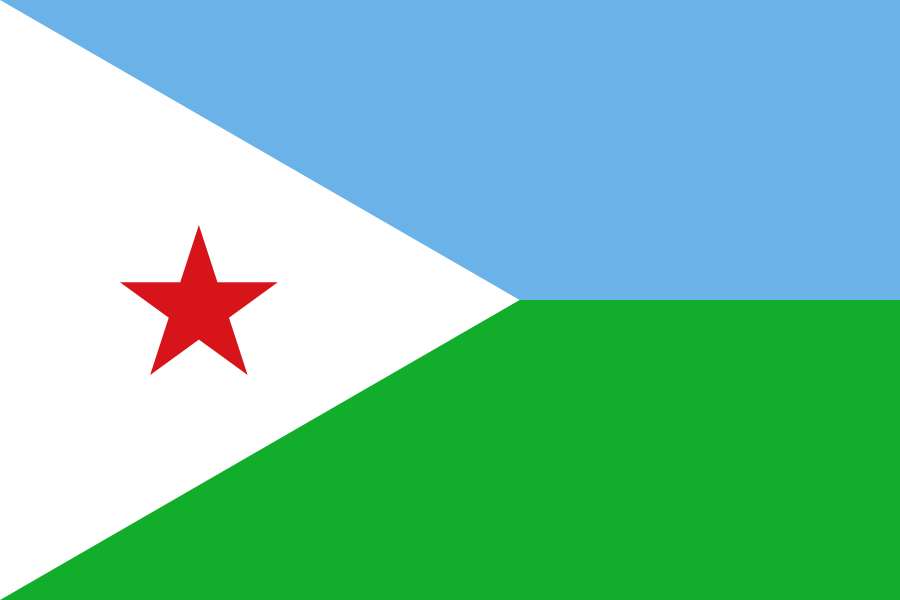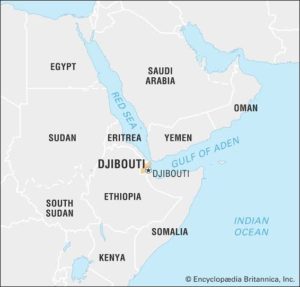
A small country located in the Horn of Africa, on the western shore of the Bab el-Mandeb strait, controlling access to the Red Sea from the Indian Ocean. Despite its small size and extremely arid climate, Djibouti occupies a geo-strategic position of the first order: it hosts military bases of powers such as the United States, China, France, Italy, and Japan, and serves as the main outlet to the sea for neighboring Ethiopia. The country is a multi-ethnic nation, with a predominantly Muslim population, whose economy depends largely on its port and regional logistics services.
History
The territory of Djibouti was part of the ancient land of Punt and, in the Middle Ages, was the cradle of the sultanates of Adel and Ifat. In the late 19th century, France established the colony of French Somaliland through treaties signed with Somali and Afar sultans . In 1967, the area was renamed the French Territory of the Afars and the Issas. After a referendum in May 1977, the country voted for independence and officially became the Republic of Djibouti on June 27, 1977, joining the UN on September 20 of that same year . In the 1990s, tensions over political representation led to an armed conflict that culminated in a power-sharing agreement in 2001 .
Culture
The population is composed mainly of two large ethnic groups: Somalis (Issa) and Afar, whose languages are recognized as national languages, although Arabic and French are the official languages . Approximately 94% of Djiboutians practice Sunni Islam, a religion that reached the region more than a millennium ago through Arab traders . Society is communal, with strong family and clan ties . The Hamoudi Mosque, built in 1906, is the oldest in the country and an important historical and religious center. Khat, a stimulant plant, is widely consumed in social gatherings in the afternoons.