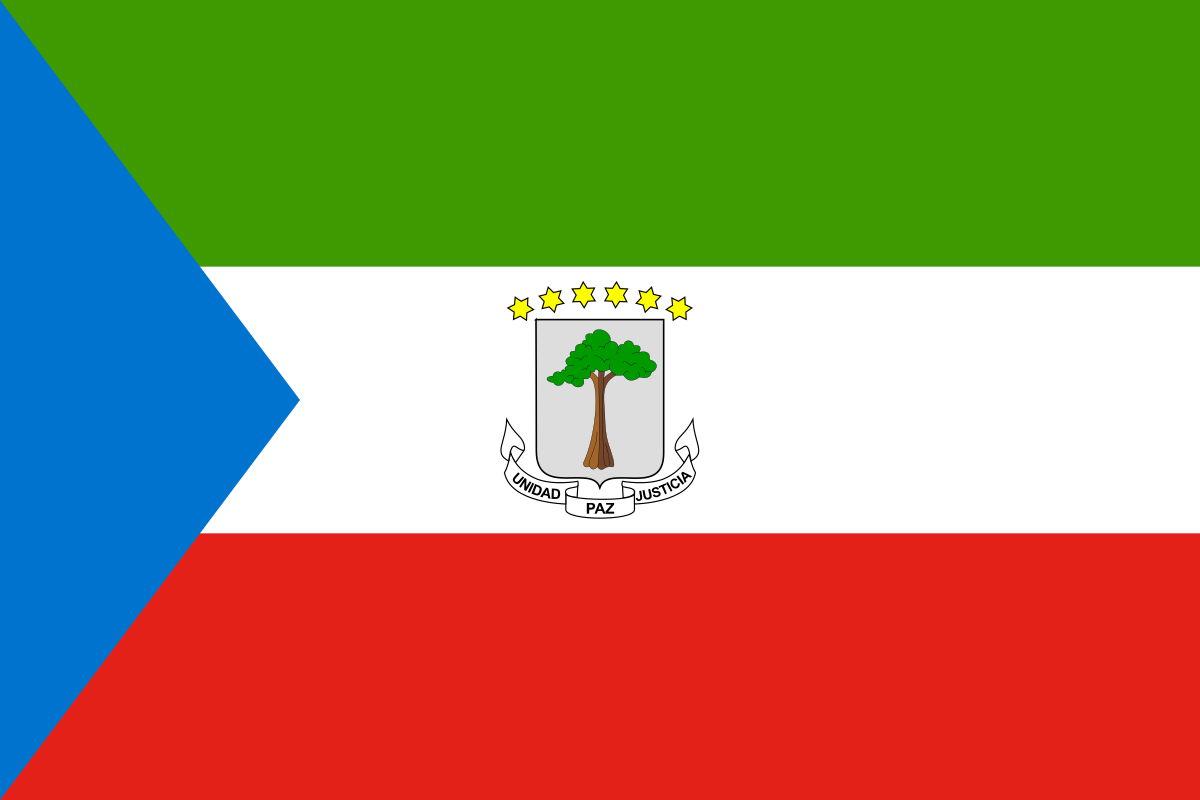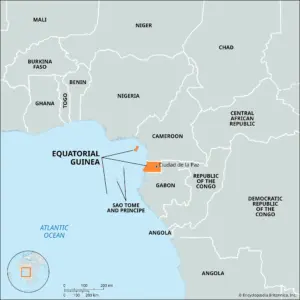
A small country located on the western coast of Central Africa, the only sovereign state in continental Africa where Spanish is an official language. Equatorial Guinea is composed of a mainland region (Río Muni) and five inhabited islands, including Bioko, where the capital, Malabo, is located. Despite its small size, the discovery of important oil reserves in the 1990s radically transformed its economy, making it one of the countries with the highest per capita income in Africa, although with enormous social inequalities.
History
The territory was inhabited by Bantu peoples for centuries. Portuguese navigators arrived in 1471, and the island of Bioko was named Fernando Poo. In 1778, Portugal ceded the territories to Spain through the Treaty of El Pardo. Spanish presence was intermittent until the mid-19th century, when colonization was formally established. In 1963, autonomy was granted, and on October 12, 1968, independence was proclaimed under President Francisco Macías Nguema, whose regime degenerated into a brutal dictatorship that caused thousands of deaths and economic collapse. In 1979, his nephew Teodoro Obiang Nguema Mbasogo overthrew him in a coup and has ruled since then, being re-elected on multiple occasions.
Culture
The population is predominantly Bantu, with two main groups: the Fang in the mainland region (approximately 75% of the population) and the Bubi on the island of Bioko (around 15%). Spanish is the official and administrative language, with French and Portuguese as co-official languages. The most widely spoken vernacular languages are Fang and Bubi. The predominant religion is Catholicism (approximately 82%), with a Muslim minority. Traditional Fang culture includes the mvet, a zither-type musical instrument, and the “house of the word” (avda), a community space where decisions are made and oral history is preserved. Fang sculptures and masks are internationally recognized.
Nature
Equatorial Guinea covers approximately 28,051 km², with a coastline of 482 kilometers. The climate is tropical humid, with average temperatures of 24 to 26°C. The mainland region is covered in more than three-quarters by humid tropical rainforest, with primary and secondary forests representing around 57% of the territory. The island of Bioko, of volcanic origin, has extremely fertile soils. Biodiversity is exceptional: more than 300 bird species, 167 freshwater fish species, and a rich variety of primates including gorillas, chimpanzees, and mandrills have been recorded. Forest elephants, hippos, and sea turtles that nest on the coasts of Bioko also inhabit the country.
Government
Equatorial Guinea is a presidential republic according to the 1982 Constitution, revised in 1991 and 2011. The President is head of state and government, elected by universal suffrage for a 7-year term, with the possibility of one re-election. Teodoro Obiang Nguema Mbasogo has held the presidency since 1979. The Prime Minister, currently Manuel Osa Nsue Nsua, is the head of government. The legislative power is bicameral: a Senate of 70 members (55 elected, 15 appointed by the president) and a Chamber of Deputies of 100 members, both with 5-year terms. The ruling party, the Democratic Party of Equatorial Guinea (PDGE), dominates the political landscape.