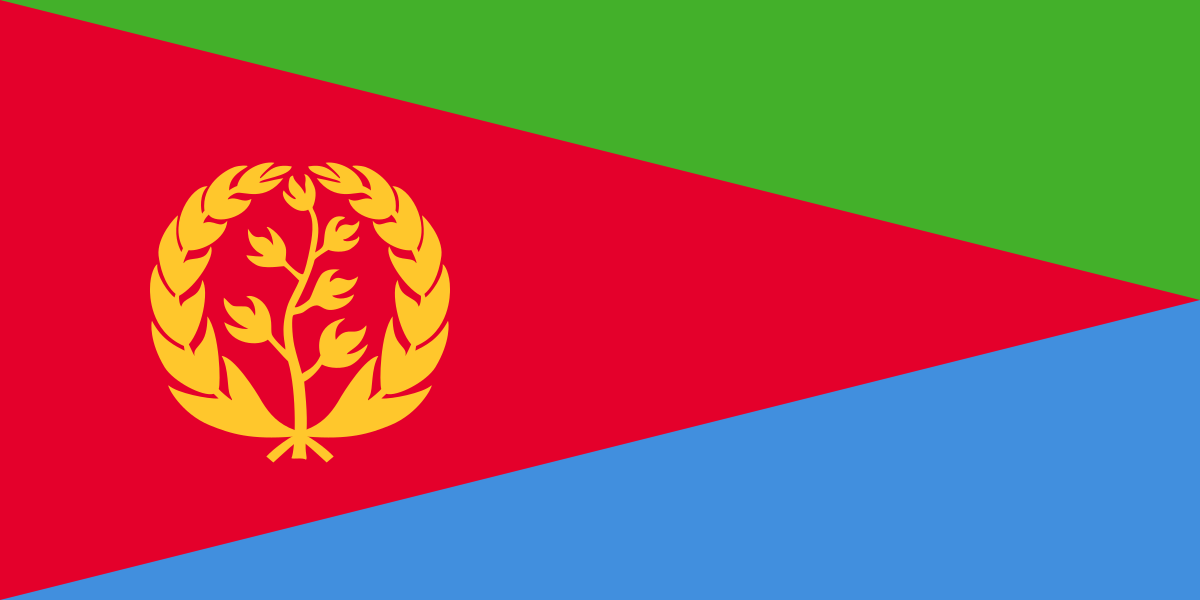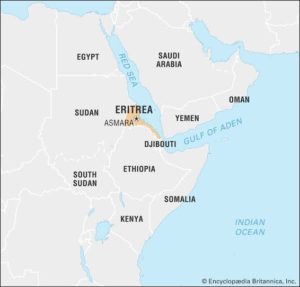
A country located in the Horn of Africa, on the Red Sea coast. Eritrea gained independence from Ethiopia in 1993 after one of Africa’s longest liberation wars. It is a one-party state governed by the same president since independence, with no national elections held since then. Its name comes from the Latin Mare Erythraeum (“Red Sea”), given by the Italians during colonization.
History
The territory was occupied successively by the Kingdom of Aksum, the Ottoman Empire, and Egypt. Italy colonized the region in 1890, unifying various lands under the name “Eritrea.” After Italy’s defeat in 1941, Eritrea came under British administration. In 1952, the UN approved a federation with Ethiopia, but Emperor Haile Selassie unilaterally dissolved it in 1962, annexing Eritrea as its 14th province. This triggered a 30-year war of independence, led by the Eritrean People’s Liberation Front (EPLF). The war ended in 1991 with the victory of the independence fighters, and after a UN-supervised referendum, Eritrea officially became independent on May 24, 1993. That same day, the Transitional National Assembly elected Isaias Afwerki as president, a position he has held ever since.
Culture
The population is composed of 9 ethnic groups, with the Tigrinya (approximately 50%) and Tigre (31.4%) being the largest, alongside the Afar, Saho, Hedareb, Bilen, Kunama, Nara, and Rashaida. The official languages are Tigrinya, Arabic, and English, although Tigre, Afar, Bilen, Kunama, Nara, and Italian are also spoken. Religion is divided roughly equally: 45% Orthodox Christian (mainly in the highlands) and 45% Muslim (in the lowlands and coast), with 10% traditional beliefs. Society is deeply conservative, and indefinite compulsory military service has marked the lives of generations.
Nature
Eritrea has an area of approximately 124,000 km², including the Dahlak archipelago. The country has three geographic zones: the central highlands (covering one-third of the territory, with altitudes from 1,800 to 3,000 meters and a temperate climate of around 17°C), the western lowlands (hot and arid), and the Red Sea coastal plains (desert, with temperatures exceeding 40°C). The highest point is Mount Amba Soira (3,013 m) and the lowest is the Kobar depression (75 m below sea level). The only permanent river is the Setit (180 km). Eritrea has 11 proposed protected areas, though none have been formally designated, resulting in 0% conservation coverage of its territory. Priority areas identified include the Gash-Setit Elephant Sanctuary and the Semienawi and Debubawi Bahri forests.
Government
Eritrea is a presidential republic with a one-party system. The President is head of state, head of government, commander-in-chief of the armed forces, and president of the State Council and National Assembly. Isaias Afwerki has held the presidency since May 24, 1993. The 1997 Constitution has never been implemented. The National Assembly (Hagerawi Baito), with 150 members, was established as a transitional legislative body, but elections scheduled for 2001 were postponed indefinitely and no functioning legislative body exists. The only legal party is the People’s Front for Democracy and Justice (PFDJ). Voting age is 18.