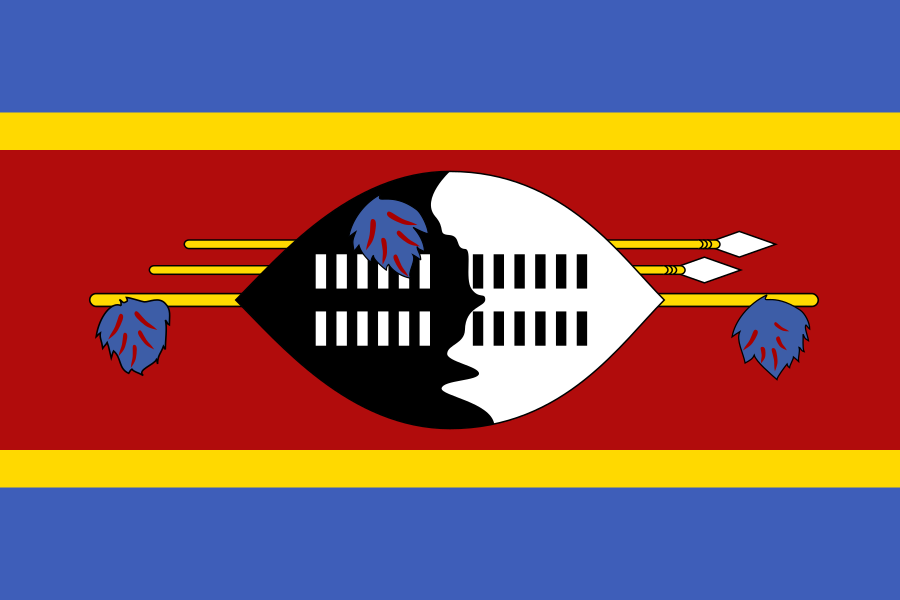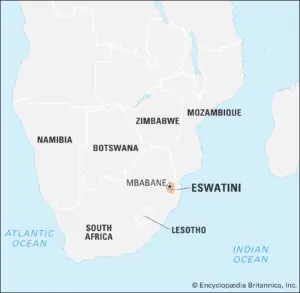
A small landlocked country in Southern Africa, situated between South Africa and Mozambique. It is one of the world’s last absolute monarchies, where the King holds executive, legislative, and judicial authority. Despite its small size, it is known for its rich cultural heritage and colorful traditional ceremonies. Its administrative capital is Mbabane, while Lobamba is the seat of royal and legislative power.
History
The Swazi people are descended from the Southern Nguni who migrated from Central Africa in the 15th and 16th centuries. The ancestors of the Swazis, the Nkosi Dlamini, broke away from the mainstream of Nguni migrants led by Chief Ngwane and settled in the Pongolo river region. By 1750, they had settled in the Hluti Region in the south of the kingdom, under King Ngwane III. The country derives its name from a later King, Mswati I. The historical evolution of the autonomy of the Swazi Nation was dictated by British rule of southern Africa in the 19th and 20th centuries. In 1881, the British government signed a convention recognizing Eswatini independence. However, controversial land and mineral rights concessions were made under the authority of the Foreign Jurisdiction Act of 1890, which also placed the administration of Eswatini under that of the then South African Republic (Transvaal). At the commencement of the Anglo Boer War, Britain placed Eswatini under its direct jurisdiction as a Protectorate. The independence Constitution was promulgated by Britain in November 1963, and elections were held in 1967. Full independence was achieved on September 6, 1968 .
Culture
Swazi society is deeply traditionalist and homogeneous. The first symbol of national identity is the monarchy, and the clan is the most important kinship group. The official languages are Swazi (siSwati) and English. The predominant religion is Christianity, although many people combine their beliefs with traditional practices. Polygamy is a traditional practice, and King Mswati III has multiple wives. Cultural ceremonies play a central role in Swazi life. The most important is Incwala, or the “First Fruits Ceremony,” which marks the traditional New Year and lasts several weeks between December and January. It is a sacred rite of spiritual renewal and purification, and the exact dates are never publicized, as they are determined by ancestral astrologers. Another notable ceremony is Umhlanga, or the “Reed Dance,” held between August and September, where thousands of young maidens cut reeds and present them to the Queen Mother, celebrating the purity of Swazi young women. In dress, suits and ties are important in business settings, and punctuality is expected, though not strict. Direct eye contact should be avoided with people of greater age or rank. When greeting, a handshake is common, holding the forearm with the left hand to make it more formal .
Nature
Eswatini has an area of 17,364 km² and is a landlocked country. Despite its small size, it presents four distinct geographic zones with varied ecosystems. The western zone (Highveld) has an average altitude of 1,300 meters and corresponds to the foothills of South Africa’s Drakensberg Mountains, with abundant pine and eucalyptus plantations. The eastern zone (Middleveld) is flatter, with an average height of 700 meters, and has fertile hills and valleys with sugar cane plantations. The Lowveld, in the south, occupies 40% of the territory, with an average height of 200 meters, and although prone to droughts, sugar cane is successfully cultivated. The Libombos mountain range forms a natural border with Mozambique. The climate varies from subtropical in the west, with rainfall exceeding 1,000 mm annually, to semi-arid tropical in the east. The most important rivers are the Usutu, Ingwavuma, and Komati. The highest point is Mount Emlembe, at 1,862 meters, and the lowest is the Usutu River, at 21 meters above sea level. Wildlife includes Africa’s “Big Five” (lion, leopard, rhinoceros, elephant, and buffalo), although populations have been reduced by excessive hunting .
Government
Eswatini is an absolute monarchy under the Tinkhundla governance system. King Mswati III is the Head of State and Ingwenyama, and ascended to the throne in 1986. He shares power with his mother, the Queen Mother or Indlovukazi, who is the symbolic figure of the nation. The King appoints the Prime Minister (currently Russell Dlamini, since November 2023) from among the members of the Assembly, and appoints the ministers. Legislative power resides in a bicameral Parliament: the Senate has 30 members (20 appointed by the King and 10 elected by the Assembly), and the House of Assembly has 69 members (59 elected by universal suffrage and 10 appointed by the King). The judicial system is dual: it includes constitutional courts that apply Roman-Dutch law and traditional Swazi courts that apply customary law. Political parties have been banned since the King’s Proclamation of 1973, and civic space is classified as “closed” by the 2024 CIVICUS Monitor .