
Ethiopia
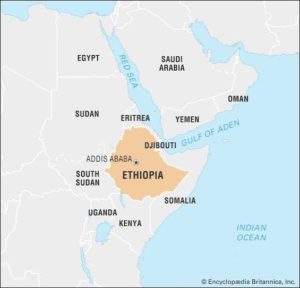
A landlocked country in the Horn of Africa, known as the “Roof of Africa” for its high plateaus. It is one of the world’s oldest nations, with a civilization spanning over 3,000 years and the only African country never formally colonized, aside from a brief Italian occupation. Ethiopia is Africa’s second most populous nation and a key diplomatic actor, hosting the headquarters of the African Union in its capital, Addis Ababa.
History
Ethiopia has a documented history dating back to antiquity. The Kingdom of Aksum, established around the 1st century AD, was a trading power that adopted Christianity in the 4th century, becoming one of the world’s first Christian states . The Solomonic dynasty, which claimed descent from King Solomon and the Queen of Sheba, ruled for centuries. In 1889, Emperor Menelik II unified the country and established the capital at Addis Ababa. In 1896, Ethiopia decisively defeated Italy at the Battle of Adwa, securing its independence . Emperor Haile Selassie ruled from 1930 until 1974, when he was overthrown by a Marxist military junta known as the Derg, led by Mengistu Haile Mariam. In 1991, the Ethiopian People’s Revolutionary Democratic Front (EPRDF) overthrew the regime, and in 1995 the current Federal Democratic Republic was established . Abiy Ahmed became prime minister in 2018 and was re-elected in 2026 .
Culture
Ethiopia is a mosaic of more than 80 ethnic groups, each with its own language and traditions . The official languages are Amharic and English, though more than 80 local languages are spoken, including Oromo and Tigrinya . The predominant religion is Ethiopian Orthodox Christianity, followed by Islam. Both communities have coexisted for centuries. The Ethiopian Orthodox Church uses Ge’ez, one of the world’s oldest liturgical languages . The national dish is injera, a fermented flatbread made from teff, served with various stews and eaten with the right hand . Coffee is central to social life, and the “coffee ceremony” is an important tradition. Traditional clothing includes the gabbi or netella, woven cotton fabrics with embroidered crosses .
Nature
Ethiopia covers approximately 1,104,300 km². Its geography is dominated by a large plateau that makes up two-thirds of the territory, with average altitudes near 3,000 meters . The highest peak is Ras Dashen, at 4,533 meters . The country hosts unique ecosystems, from moist montane forests to Afroalpine zones and deserts . Simien Mountains National Park, a UNESCO World Heritage Site, is a refuge for endemic species such as the gelada baboon, Ethiopian wolf, and Walia ibex . Awash National Park, in the Rift Valley, protects acacia savannas and rich birdlife .
Government
Ethiopia is a federal parliamentary republic under the 1994 Constitution . The head of state is the President, a largely ceremonial role elected by parliament for a six-year term. Real executive power resides in the Prime Minister, who is the head of government and is elected by the majority party in the House of Peoples’ Representatives . The legislative branch is bicameral: the House of Peoples’ Representatives (lower chamber, 547 members) and the House of the Federation (upper chamber, representatives of the regions). The judiciary is independent, with the Federal Supreme Court at its apex . The country is divided into eleven ethnic regional states and two chartered cities, Addis Ababa and Dire Dawa . The current prime minister is Abiy Ahmed, whose Prosperity Party won the 2026 elections .
Products:
No products were found matching your selection.



