
Gabon
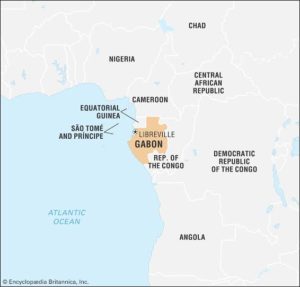
A country located on the western coast of Central Africa, crossed by the Equator. Gabon is known for its extraordinary biodiversity and for being one of the countries with the highest forest cover in the world, with almost 90% of its territory covered by rainforest. Despite its wealth in oil, manganese, and timber, the economy remains heavily dependent on natural resources, and the country was marked by more than five decades of political dominance by the Bongo family, until the 2023 coup d’état opened a new chapter in its history.
History
The territory was inhabited by Bantu peoples who migrated from East Africa in the 12th century and established tribal kingdoms along the Ogooué River . Portuguese navigators arrived in the 15th century and gave the country the name “Rio de Gabão” (River of the Cabin), which later became Gabon . In the 18th century, the region became a French colony, and in 1910 it became part of French Equatorial Africa . After a brief period under German administration and its subsequent return to France after World War I, Gabon became an autonomous territory within the French Community in 1958 and achieved independence on August 17, 1960, with Léon Mba as its first president .
In 1967, following Mba’s death, Vice President Omar Bongo assumed the presidency and established a one-party regime that guaranteed political stability unusual for the region . In 1990, multi-party politics was introduced, although the Gabonese Democratic Party (PDG) maintained control of power . After Omar Bongo’s death in 2009, his son Ali Bongo Ondimba was elected president in elections questioned by the opposition . The 2016 and 2023 elections were marked by irregularities and post-election violence . On August 30, 2023, after the announcement of Ali Bongo’s re-election, a group of soldiers led by General Brice Clotaire Oligui Nguema seized power, dissolved the institutions, and ended 56 years of Bongo family rule . In April 2025, Oligui Nguema was elected president with 94.85% of the vote in transition elections .
Culture
Gabon is a mosaic of approximately 50 ethnic groups, none of which constitutes an absolute majority. The most numerous are the Fang (32%), followed by the Mpongwè, Mbédé, Punu, Batéké, and Bakota . French is the official language and serves as a lingua franca among the different groups, while more than 40 national languages are spoken, mostly from the Bantu family . The population is predominantly Christian, although many traditional practices, such as Bwiti, a spiritual tradition of the Fang and Mitsogo that includes night ceremonies, music, and vision quests, remain influential .
Gabonese culture is known for its traditional masks, which represent ancestors, spirits, or symbols of nature and are used in ritual dances and ceremonies . Music occupies a central place in daily life, with instruments such as the ngombi (traditional harp) and the balafon (wooden xylophone) . The national dish is poulet nyembwe, a chicken stew with palm nut sauce, served with rice or cassava .
Nature
Gabon covers an area of 267,667 km² and borders Equatorial Guinea, Cameroon, and the Republic of the Congo. Its geography is dominated by humid tropical rainforest, which covers about 90% of the territory . The country is home to 13 national parks created in 2002, which protect more than 11% of the terrestrial territory and more than 26% of marine waters and exclusive economic zones . Lopé National Park and Ivindo National Park are UNESCO World Heritage sites .
Gabon is a critical refuge for biodiversity: it hosts more than half of Africa’s forest elephant population, a critically endangered species, as well as gorillas, chimpanzees, and panthers . Loango National Park, on the coast, is known for its beaches where large mammals, such as elephants and hippos, stroll and enter the Atlantic Ocean, and it hosts one of the world’s largest concentrations of whales and dolphins . In 2025, the government signed an agreement with the Wildlife Conservation Society (WCS) to establish collaborative management partnerships in Ivindo, Loango, Lopé, and Mayumba parks, with the aim of strengthening conservation and promoting sustainable tourism .
Government
Following the August 2023 coup d’état, Gabon is in a process of political transition. A new constitution, approved by referendum in November 2024, established a presidentialist system that eliminated the position of prime minister and granted broad powers to the president . The president is head of state and government, elected by universal suffrage for a 7-year term, with the possibility of one re-election . Brice Clotaire Oligui Nguema was invested as president in May 2025 after winning the April elections .
Legislative power resides in a bicameral parliament: the National Assembly (98 members in the transition) and the Senate (70 members in the transition) . The judicial system includes a Constitutional Court of nine members with seven-year terms, a Court of Cassation, a Council of State, and a Court of Accounts . The country is divided into 9 provinces and maintains a multi-party system, although the ruling party after the transition, the Committee for the Transition and Restoration of Institutions (CTRI), controls the main state institutions .
Products:
No products were found matching your selection.



