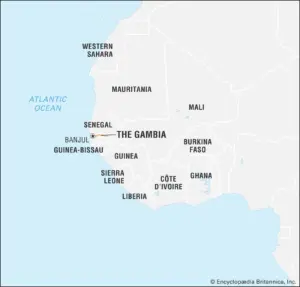
A small country located on the western coast of Africa, completely surrounded by Senegal except for its Atlantic façade. It is the smallest country on the African continent, with only 11,295 km², and its territory extends along the banks of the Gambia River, which gives it its name. Historically known as a key point in the transatlantic slave trade, it is today a presidential republic undergoing a complex process of democratic consolidation after two decades of authoritarian rule.
History
The territory was inhabited by various ethnic groups, mainly Mandinka, Wolof, and Fulani, who established kingdoms such as the Mali Empire and the Jolof kingdom. The Portuguese arrived in the 15th century, followed by the English and French. In 1783, the Treaty of Versailles assigned the banks of the Gambia River to Great Britain, while Senegal went to France. The current border was fixed by Anglo-French agreement in 1889.
The Gambia gained independence from the United Kingdom on February 18, 1965, and became a republic in 1970. Dawda Jawara, of the People’s Progressive Party, ruled for decades until in 1994 Lieutenant Yahya Jammeh led a coup d’état. Jammeh stayed in power through questioned elections in 1996, 2001, 2006, and 2011, establishing an authoritarian regime marked by human rights violations.
In December 2016, a coalition of seven opposition parties brought Adama Barrow to power, defeating Jammeh. After a brief attempt by Jammeh to hold onto power, ECOWAS military intervention forced him into exile. Barrow was sworn in in February 2017 and re-elected in December 2021 with 53.2% of the vote.
Culture
The Gambian population is ethnically diverse but culturally integrated, a distinctive trait of the country. The main groups are Mandinka (34.4%), Fulani (25%), Wolof (15.4%), Jola (9.5%), and Serahule (8.2%). English is the official language, although Mandinka, Wolof, Fula, and other local languages are widely spoken.
Islam is the predominant religion, practiced by more than 90% of the population, with Christian and animist minorities. Gambian society combines Islamic practices with ancestral traditions, and interethnic and interreligious relations are generally harmonious. The country is known for its tradition of “unity in diversity,” a notable achievement in a region marked by ethnic conflicts.
Gambian culture includes rich oral traditions, music with instruments such as the kora (21-string harp) and balafon, and ceremonial dances. Literature and art also flourish, with figures such as Lenrie Peters. Cuisine is based on rice, millet, corn, fish, and peanuts, with dishes such as benachin (rice with fish and vegetables) and domoda (peanut stew).
Nature
The Gambia presents a landscape of alluvial plain crossed by the Gambia River, which flows from east to west along some 480 navigable km. The country’s highest point barely reaches 53 meters above sea level. The climate is tropical, with a dry season from November to May and a rainy season from June to October.
Despite its small size, The Gambia harbors remarkable biodiversity. A total of 3,335 species have been recorded, including 125 mammals, 576 birds, 74 reptiles, 33 amphibians, and 627 fish. Wetlands cover approximately 20% of the territory, and three sites are designated under the Ramsar Convention: Baobolon Wetland Reserve, Niumi National Park, and Tanbi Wetland Complex.
Niumi National Park, on the border with Senegal, is a complex of coastal wetlands that hosts 303 species of resident and migratory birds, as well as the West African manatee, leopards, and red colobus monkeys. The Tanbi Wetland Complex, near Banjul, protects mangroves that serve as a breeding ground for shrimp and habitat for the manatee and African clawless otter. The Gambia has 22 protected areas covering 6.4% of the land surface, plus 66 forest reserves.