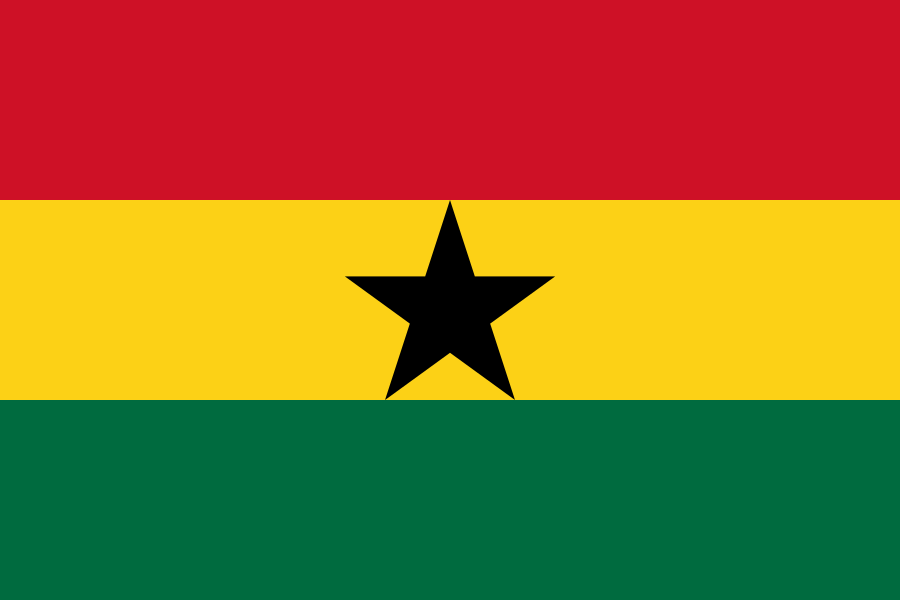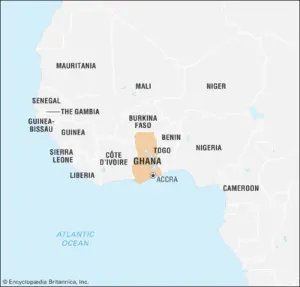
A country located on the Gulf of Guinea in West Africa, considered one of the most stable and democratic states on the continent. It was the first nation in sub-Saharan Africa to gain independence from colonial rule, in 1957, under the leadership of Kwame Nkrumah, becoming a symbol of Pan-Africanism. Its name comes from the ancient Ghana Empire, although geographically the current country is located further south. It is Africa’s second-largest gold producer and a major cocoa exporter.
History
The territory was occupied by various kingdoms and states, including the Ashanti Empire, which dominated the central region during the 18th and 19th centuries . The Portuguese arrived on the coast in the 15th century and named it the “Gold Coast” due to its abundant gold resources . Subsequently, the Dutch, British, and Danes established trading posts, and the region became a key center of the transatlantic slave trade .
In 1897, the entire territory became a British colony under the name Gold Coast. After decades of anti-colonial resistance, Ghana achieved independence on March 6, 1957, led by Kwame Nkrumah, who became the first president of the republic in 1960 . Nkrumah was overthrown in 1966, and the country experienced a long series of coups until Lieutenant Jerry Rawlings took power in 1981 .
In 1992, a new constitution was approved that restored multi-party politics, and Rawlings won the elections that year and in 1996. In 2000, peaceful alternation was consolidated with the victory of John Kufuor of the New Patriotic Party (NPP) . Since then, Ghana has maintained a trajectory of democratic stability with regular alternations between the NPP and the National Democratic Congress (NDC). In the December 2024 elections, John Dramani Mahama of the NDC won and assumed the presidency on January 7, 2025 .
Culture
Ghana is a country of great ethnic diversity, with more than eighty ethnolinguistic groups. The Akan constitute the majority group, with approximately 47% of the population, followed by the Mole-Dagbon, Ewe, Ga-Dangme, Gurma, and Guan . English is the official language, although local languages such as Akan, Ewe, Ga, and Dagbani are widely spoken .
The predominant religion is Christianity (approximately 70%), followed by Islam (around 20%), with 10% practicing traditional religions or other beliefs . Ghanaian society is known for its hospitality and the importance it places on family and community ties.
Ghanaian culture is dynamic and has successfully integrated external influences. Highlife, a musical genre that fuses traditional rhythms with Caribbean and European influences, is the country’s most representative style . In the 1990s, hiplife emerged, a fusion of rap with local rhythms and dialects, which has produced internationally renowned artists . Traditional dress includes vibrantly colored fabrics such as kente, a ceremonial cloth of great symbolic value. Cuisine is based on tubers such as yam and cassava, with dishes such as fufu and banku, accompanied by soups and stews.
Nature
Ghana covers an area of 238,537 km² and has two main biomes: tropical forest in the south and savannas in the north, subdivided into six agro-ecological zones . The climate is tropical, with a rainy season from April to September and a dry season from November to April. The highest point is Mount Afadjato (885 m) .
The country harbors remarkable biodiversity: 728 bird species, 225 mammal species, and 221 amphibian and reptile species have been recorded . Mole National Park, in the north, is the largest in the country and is home to elephants, antelopes, and primates. Kakum National Park, near the coast, is famous for its elevated canopy walkway. Ghana has been a pioneer in community-based ecotourism, with projects such as the Boabeng-Fiema Monkey Sanctuary and the Wechiau Hippo Sanctuary .
However, biodiversity faces serious threats. Between 1900 and 1990, Ghana lost 80% of its forest cover due to logging, slash-and-burn agriculture, and mining . The country was the first to lose a major primate species (the red colobus monkey) since the Convention on Biological Diversity came into force .