
Guinea
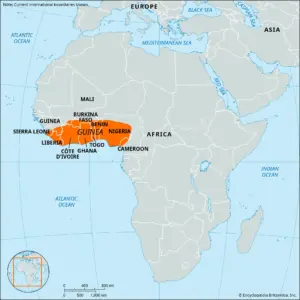 A country located on the western coast of Africa, known as the “water tower of West Africa” because three of the region’s most important rivers—the Niger, Senegal, and Gambia—originate in its highlands. Guinea is the world’s largest exporter of bauxite, a strategic mineral for aluminum production. Since its independence in 1958, when it rejected integration into the French Community under the leadership of Sékou Touré, the country has alternated between periods of authoritarian rule and truncated democratic transitions, currently finding itself under a military regime that has postponed a return to constitutional order.
History
The territory that is now Guinea was part of the great West African empires, including the Ghana Empire (9th-13th centuries) and the Mali Empire (13th-15th centuries), which spread Islam throughout the region . After the fall of these empires, local kingdoms emerged, such as Futa Yallon, consolidated by the Fulani in the 18th century as an important Islamic center .
The Portuguese arrived on the coast in the 15th century and initiated the transatlantic slave trade, followed by other European powers . France established its colonial rule in the late 19th century, integrating Guinea into French West Africa .
In 1958, under the leadership of Ahmed Sékou Touré, Guinea became the first francophone territory in West Africa to reject the French Community and declare independence on October 2, 1958 . Touré ruled as a socialist dictator until his death in 1984, with a one-party regime that harshly repressed dissent .
After Touré’s death, Colonel Lansana Conté seized power in a coup and ruled until 2008 . In 2010, after a period of military transition, Alpha Condé won the country’s first democratic elections . Condé was re-elected in 2015 and in 2020 after a controversial constitutional reform that allowed him a third term, triggering massive protests .
On September 5, 2021, Colonel Mamady Doumbouya led a coup that overthrew Condé, dissolved the institutions, and established a military junta, the National Committee for Reconciliation and Development (CNRD) . In September 2025, a new constitution was approved in a referendum that extended the presidential term to seven years and allowed military personnel to run for office . Doumbouya won the December 2025 presidential elections and took office in January 2026 .
Culture
Guinea is home to more than twenty ethnic groups, with three majority ones: the Fulani (or Peuhl) represent approximately 33.9% of the population and predominate in the Futa Yallon region; the Malinké constitute around 30% and live mainly in Upper Guinea; and the Susu represent about 20% and are concentrated in Maritime Guinea .
French is the official language, although each ethnic group preserves its own language, notably Pular (Fulani), Malinké, and Susu . The predominant religion is Islam, practiced by approximately 85% of the population, with Christian (8%) and animist (7%) minorities .
Ethnic and regional identity has historically been linked to political affiliation, and tensions between the main groups have intensified during electoral periods . The Fulani, despite being the largest group, have never held the presidency, generating persistent grievances .
Nature
Guinea covers 245,857 km² and is divided into four natural geographic regions :
Lower Guinea or Maritime Guinea (18% of the territory): coastal zone with mangroves, estuaries, lagoons, and plains, where the capital, Conakry, is located. The Susu ethnic group predominates .
Middle Guinea or Futa Yallon (20%): plateaus and mountains exceeding 700 meters, with Mount Loura (1,538 m) as the highest point. This region is the source of the Niger, Senegal, and Gambia rivers, earning Guinea the nickname “water tower of West Africa” .
Upper Guinea (41%): vast savanna with altitudes of 200 to 400 meters, crossed by the Niger River and its tributaries. The Malinké group predominates. The region faces threats of desertification .
Forest Guinea (20%): mountainous region covered with virgin forests, culminating in Mount Nimba (1,752 m), declared a UNESCO World Heritage Site for its iron wealth and biodiversity .
Biodiversity faces significant pressures from deforestation, soil degradation, and agricultural expansion .
Government
Guinea is officially a presidential republic, although since the 2021 coup it has been governed under a military transition regime .
The new constitution, approved by referendum in September 2025, establishes a presidential term of seven years, renewable once, and eliminates restrictions that prevented military personnel from running for office . The president is head of state and government, and also serves as Minister of Defense .
President Mamady Doumbouya, leader of the 2021 coup, won the December 2025 elections and took office in January 2026 . Prime Minister Amadou Oury Bah was appointed in February 2026 .
Legislative power is in transition: parliament was dissolved in 2021 and replaced by a National Transition Council. The new constitution establishes a bicameral parliament, and legislative elections are planned for May 2026 .
The judicial system includes a Supreme Court as the highest body, with jurisdiction to resolve disputes between the executive and legislative branches. Judges are appointed on the recommendation of the Superior Council of the Judiciary .
The human rights situation remains critical. International organizations denounce arbitrary arrests of opponents, forced disappearances, dissolution of political parties, restrictions on press freedom, and bans on demonstrations .
Products:
No products were found matching your selection.



