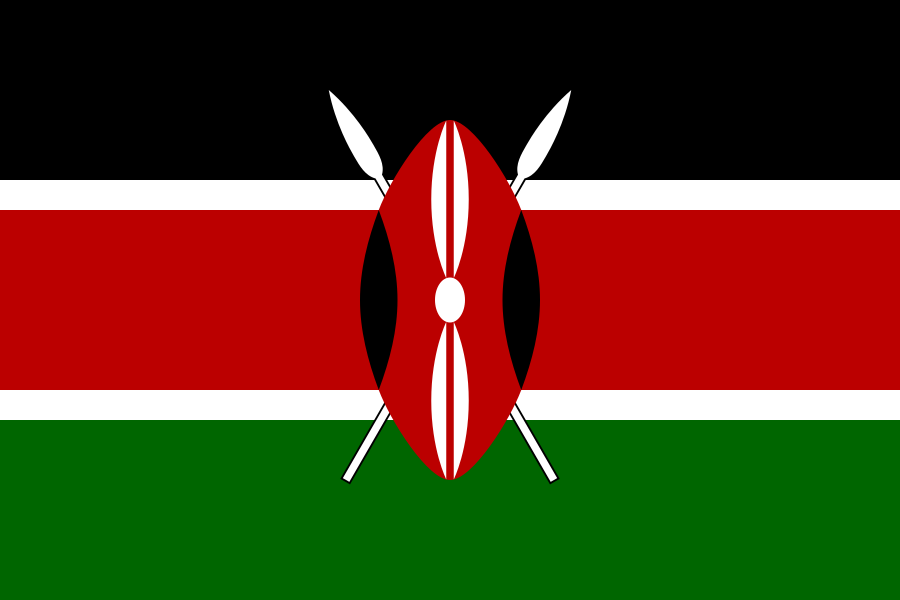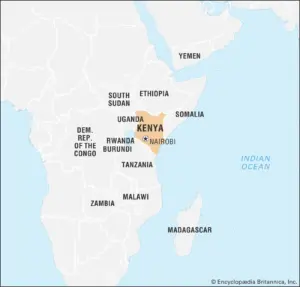
A country located in East Africa, crossed by the Equator and the Great Rift Valley. It is known worldwide as a “wildlife paradise” for its vast savannas, national parks, and the annual Great Migration of wildebeest and zebras in the Maasai Mara. Kenya is the largest economy in East Africa and a regional hub for trade, finance, and communications. It was a British colony and achieved independence in 1963 after an anti-colonial struggle marked by the Mau Mau rebellion. Its name comes from Mount Kenya, the second-highest mountain in Africa.
History
The territory was inhabited by Bantu and Nilotic-speaking peoples for centuries. Arab traders established coastal posts from the 8th century, and the region was contested by the Portuguese and Omanis before coming under British influence in the 19th century. In 1895, the British East Africa Protectorate was established, and in 1920 the area became the Colony of Kenya.
Anti-colonial resistance culminated in the Mau Mau rebellion (1952-1960), led mainly by the Kikuyu ethnic group against British rule. The repression was severe: more than 1.5 million Kenyans were detained during the state of emergency. The Lancaster House Conferences (1960-1963) negotiated the constitutional framework for independence.
Kenya attained internal self-government (Madaraka) on June 1, 1963, and full independence on December 12, 1963, with Jomo Kenyatta as prime minister. Exactly one year later, on December 12, 1964, Kenya became a republic, with Kenyatta as president. The country maintained a one-party system until 1991, when multi-party politics was restored. Since then it has held regular elections, though with episodes of post-election violence, especially in 2007-2008. The 2010 Constitution introduced a decentralized system of government with 47 counties.
Culture
Kenya is home to 44 officially recognized ethnic groups. The main ones are the Kikuyu (17%), Luhya (14%), Kalenjin (11%), Luo (10%), and Kamba (10%). The official languages are Swahili (national lingua franca) and English, although there are about a hundred mother tongues. Most urban Kenyans are fluent in three languages: their mother tongue, Swahili, and English.
The predominant religion is Christianity (approximately 85%), with 48% Protestant and 24% Catholic, followed by a Muslim minority (11%), concentrated on the coast and in the northeast. Traditional animist practices also persist.
Kenyan culture is diverse and dynamic. Contemporary literature, music, and art have an international presence. Swahili is a Bantu language with strong Arab influence, and the coast has a distinctive Swahili heritage reflected in the architecture of Lamu and Mombasa. Cuisine includes dishes such as nyama choma (roasted meat) and ugali (maize meal), which accompanies almost every meal.
Nature
Kenya covers 580,367 km² and has a geography dominated by the Great Rift Valley, which cuts through the country from north to south, and Mount Kenya (5,199 m), the second-highest peak in Africa and a World Heritage Site. The climate is tropical, varying with altitude and proximity to the ocean.
The country is a world-class wildlife destination. It has more than 60 national parks, reserves, and conservancies. Notable ones include:
-
Maasai Mara: scene of the annual Great Migration of over a million wildebeest and zebras, considered one of the New Seven Wonders of the World.
-
Amboseli: famous for its views of Kilimanjaro and its large elephant herds.
-
Nairobi National Park: the only national park in the world located less than 10 km from a capital city.
-
Lake Nakuru: bird sanctuary, especially for flamingos.
-
Aberdares and Mount Kenya: mountain ecosystems with forests and waterfalls.
Kenya is home to the “Big Five” (lion, leopard, elephant, rhinoceros, and buffalo), as well as rare species such as Grevy’s zebra and the reticulated giraffe. The country has six Ramsar wetlands, including Lake Naivasha and the Tana River Delta. Conservation is a national priority, with the Kenya Wildlife Service (KWS) as the main agency. Kenya was the first country to publicly burn its ivory stockpiles to send a message against the illegal trade.
Government
Kenya is a presidential republic governed by the 2010 Constitution. The President is head of state, head of government, and commander-in-chief of the armed forces. The President is elected by universal suffrage for a 5-year term, renewable once. To win in the first round, a candidate must obtain more than 50% of the vote nationally and at least 25% in 24 of the 47 counties. The current president is William Ruto, elected on August 9, 2022, with 50.5% of the vote.
Legislative power resides in a bicameral Parliament: the National Assembly (lower chamber) and the Senate (upper chamber), which represents the counties. The judicial system is independent and hierarchical, with the Supreme Court as the highest body, followed by the Court of Appeal and the High Court.
Kenya is a unitary state with devolved government. The territory is divided into 47 counties, each with its own governor and local assembly, with responsibilities in health, agriculture, infrastructure, and other services. The country has a multi-party system and holds general elections every five years.