
Lesotho
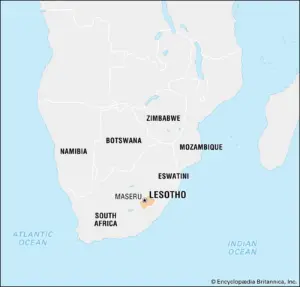
A small landlocked country, completely surrounded by South Africa, known as the “Mountain Kingdom” or “Kingdom in the Sky” because its entire territory lies above 1,000 meters in elevation. It is one of the three remaining monarchies in Africa and the only country in the world whose lowest point is at that altitude. Its economy depends heavily on remittances from miners working in South Africa, customs union revenues, and water sales to its neighbor. Despite its size, Lesotho possesses an extraordinarily cohesive Basotho cultural identity and a history of resistance and diplomacy that allowed it to preserve its sovereignty against more powerful settlers and armies.
History
The first inhabitants were the San (Bushmen), later displaced by Bantu peoples. By around 1400 AD, Sotho-speaking peoples had settled in the region. The birth of the Basotho nation occurred around 1818, when Moshoeshoe I forged alliances with various clans and chiefdoms to unify them against a period of widespread violence known as the Lifaqane, triggered by Shaka’s Zulu expansion and drought .
Moshoeshoe established his impregnable fortress on the Thaba Bosiu plateau, from where he resisted attacks by larger armies. Rather than conquering, he integrated refugees and former enemies, offering them land and protection, thus creating a nation from scattered fragments . Facing incursions by Boer settlers, Moshoeshoe sought British protection, and in 1868 Basutoland became a British protectorate, a status that preserved its internal autonomy .
Lesotho gained independence from the United Kingdom on October 4, 1966, adopting the name Kingdom of Lesotho under a constitutional monarchy . The early years were marked by instability: Prime Minister Leabua Jonathan suspended the constitution in 1970 after losing elections, ruling by decree until a military coup in 1986. Civilian rule was restored in 1993, but a post-election crisis in 1998 required military intervention by South Africa and Botswana . Since the 2002 constitutional reforms, the country has enjoyed relative political stability, with peaceful elections and alternation of power. The current prime minister is Samuel Ntsokoane Matekane, who took office in October 2022 .
Culture
Lesotho’s culture is remarkably homogeneous, dominated almost exclusively by the Basotho people. The national language is Sesotho, and society is organized around villages administered by a chief, where community decisions are made in meetings called pitsos, open to all adults .
The country’s historical and cultural center is Morija, founded in 1833 as the first mission settlement. Known as Selibeng sa Thuto (The Well of Knowledge), it houses the oldest museum and archival institution in the kingdom, the 19th-century stone church, and the Maeder House (1843), the oldest standing building. Morija was the intellectual home of Thomas Mofolo, considered the first great novelist in an African language, author of Chaka (1925) .
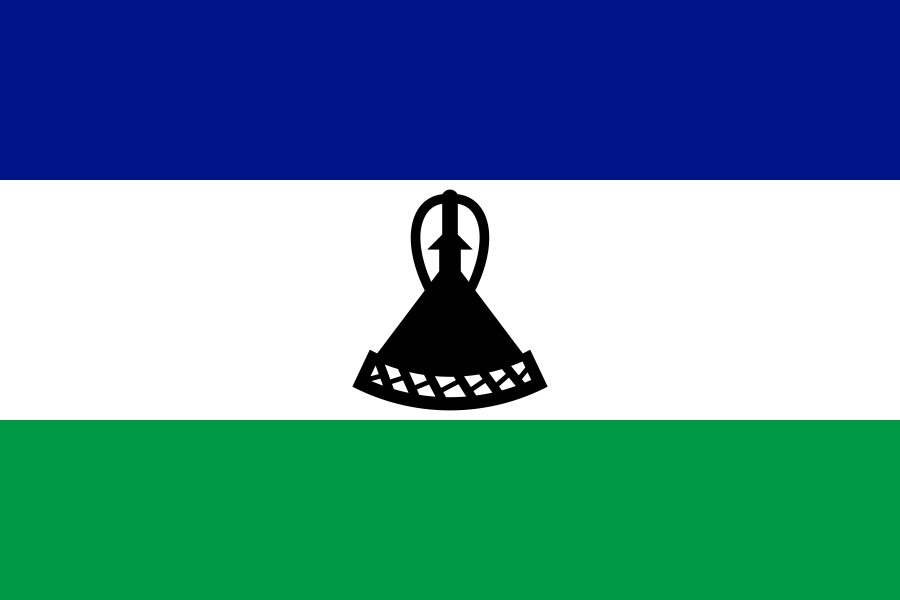
Clothing is a symbol of identity: the brightly colored Basotho blanket, worn instead of coats, and the conical mokorotlo hat, which appears even on the national flag. Traditional music includes group singing and instruments such as the lekolulo (herdsman’s flute), the setolo-tolo (mouth harp type), and the thomo (string instrument played by women). Cuisine is based on maize, consumed as thick porridge or bread, accompanied by beef, chicken, or lamb, and sorghum beer .
The Moshoeshoe Walk, an annual 116-km trek retracing the founding king’s historic route from Menkhoaneng to Thaba Bosiu, has become an important cultural tradition bringing together participants from across the region to connect with the country’s history and values of unity .
Nature
Lesotho covers 30,355 km² and is the only country in the world whose entire territory lies above 1,000 meters in elevation. The highest point is Thabana Ntlenyana (3,482 m), the highest peak in Southern Africa .
The country is divided into four agro-ecological zones:
-
Lowlands (17%): most populated zone, with soils prone to erosion.
-
Foothills (15%): between 1,800 and 2,000 m, with fertile soils and cooler temperatures, suitable for fruit trees.
-
Mountains (59%): the largest zone, with deep valleys and gorges, the main grazing area. The headwaters of the Senqu (Orange) River originate here, constituting a crucial water resource for the region .
-
Senqu River Valley (9%): narrow, arid strip, in the orographic rain shadow of the Drakensberg .
The climate is temperate, with cold, dry winters and warm, wet summers. Altitude moderates temperatures, allowing snow in high areas during winter. Natural resources include water, agricultural and grazing land, diamonds, sand, clay, and building stone .
Government
Lesotho is a parliamentary constitutional monarchy. King Letsie III is the head of state, a largely ceremonial role with no executive or legislative powers under the constitution. Succession is hereditary, but the College of Chiefs has the power to depose the monarch or determine the line of succession .
The Prime Minister is the head of government and leader of the majority party or coalition in the National Assembly. The current prime minister is Samuel Ntsokoane Matekane, leader of the Revolution for Prosperity (RFP) party, governing with a three-party coalition since October 2022 .
Legislative power resides in a bicameral Parliament, composed of the National Assembly and the Senate. The judiciary is independent, with a Court of Appeal and a High Court as the highest instances. Judges are appointed by the monarch on the advice of the prime minister and the Judicial Service Commission, and may serve until age 75 .
The 1993 Constitution (effectively restoring the 1967 version) is in force. Amendments affecting fundamental rights, the sovereignty of the kingdom, or the powers of Parliament require approval by a majority in the National Assembly, approval by the Senate, ratification in a referendum, and royal assent. Other amendments require a two-thirds majority in both houses .
Products:
No products were found matching your selection.



