
Libya
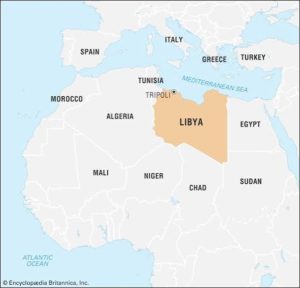
A country located in North Africa, bordered by the Mediterranean Sea to the north, with a vast desert expanse covering more than 90% of its territory. Libya is the fourth-largest country in Africa and holds the continent’s largest proven oil reserves. Since the overthrow of Muammar Gaddafi in 2011, the country has been mired in deep political and institutional fragmentation, with rival governments in the east and west, and a national reconciliation process that is advancing slowly.
History
The Libyan territory has been inhabited since prehistoric times and saw the flourishing of the Garamantian civilization in the central Sahara . Phoenicians, Greeks, and Romans established colonies along the coast, and the ruins of Sabratha, Leptis Magna, and Cyrene bear witness to the region’s classical prosperity . In the 7th century, Arab conquerors imposed Islam and the Arabic language. Between the 16th and 20th centuries, Libya was part of the Ottoman Empire until 1911, when Italy invaded and colonized the country after the Italo-Turkish War . Anti-colonial resistance was fierce, led by figures such as Omar al-Mukhtar, and was not fully suppressed until the 1930s.
After World War II, the UN administered the territory, and in 1951 Libya became independent as a monarchy under King Idris I . In 1969, Colonel Muammar Gaddafi overthrew the king in a coup and established a revolutionary regime that lasted 42 years, characterized by Arab nationalism, oil nationalization, and a system of “people’s committees” . In 2011, amid the Arab Spring, a popular uprising backed by a NATO military intervention toppled Gaddafi, who was captured and killed . Since then, the country has remained divided between rival factions.
Culture
Libyan society is predominantly Arab, with a significant Berber (Amazigh) minority, especially in the Nafusa Mountains and the Ghat oasis . Arabic is the official language, though Berber (Tamazight) is also spoken in communities in the west and south. The predominant religion is Sunni Islam (98%), with a small Ibadi community in the Nafusa Mountains . The country is organized into some 140 tribes and clans, whose social weight remains relevant, especially in rural areas .
Libyan cuisine combines Mediterranean, North African, and Berber influences . The basic ingredients are olives and olive oil, dates, grains, and milk . The national dish is bazin, an unleavened bread served with meat or vegetable stews. Also notable are couscous, shurba (soup), and pasta dishes inherited from the Italian colonial era . Alcohol consumption is prohibited throughout the country .
Regarding heritage, Libya has five UNESCO World Heritage sites: the archaeological sites of Cyrene, Leptis Magna, and Sabratha, the rock art site of Tadrart Acacus, and the oasis city of Ghadamès . Traditional arts include weaving, embroidery, metal engraving, and leatherwork, with geometric and arabesque designs .
Nature
Libya has an area of 1,759,540 km² and a Mediterranean coastline of approximately 1,900 km . The country is divided into three major historical regions: Tripolitania in the northwest, Cyrenaica in the northeast, and Fezzan in the south, a vast desert region . The climate is Mediterranean along the coastal strip and desert in the interior, with extreme temperatures and scarce rainfall. The highest point is Bikku Bitti (2,267 m) in the far southeast .
Despite its aridity, Libya hosts ecosystems of great value. Along the coast, the Farwa Lagoon, Garah Island, and Ain El-Ghezala stand out as three pilot marine areas for conservation . In the south, the Ubari Lakes basin is a unique Saharan oasis ecosystem facing severe degradation from water overexploitation and climate change. A project funded by the Global Environment Facility (GEF) and implemented by UNDP aims to restore 225 hectares of lake and oasis ecosystems and lay the groundwork for a future Ubari Lakes National Park of 100,000 hectares .
Marine biodiversity includes species such as the loggerhead turtle and the bottlenose dolphin, although the lack of systematic data hinders a complete assessment . Fishing and oasis agriculture are traditional economic activities in coastal and inland areas.
Government
Libya has been in a situation of political transition since 2011. There is no permanent constitution; the governing legal framework is the 2011 Constitutional Declaration and subsequent agreements . Legislative power resides in the House of Representatives (elected in 2014), based in Tobruk (east), which exercises legislative and oversight functions . There is also a State Council with consultative functions .
The head of state is a three-member Presidential Council, chaired by Mohammad Younes Menfi since February 2021, within the framework of the UN-facilitated political dialogue process . The Government of National Unity (GNU), based in Tripoli and led by Abdul Hamid Dbeibah, is internationally recognized, but a rival government based in the east, backed by the House of Representatives, controls large parts of the country . The country is administratively divided into 22 districts (baladiyat) .
The voting age is 18 . Presidential and parliamentary elections, initially scheduled for December 2021, have been postponed multiple times due to disagreements over the constitutional framework and the eligibility of candidates .
Products:
No products were found matching your selection.



