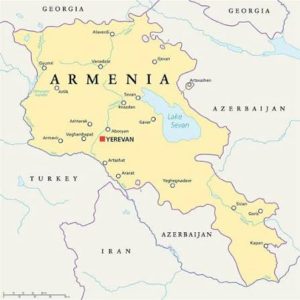
 Armenia is located in the South Caucasus region of Eurasia, situated at the crossroads of Eastern Europe and Western Asia. It is a landlocked, mountainous country bordered by Turkey to the west, Georgia to the north, Azerbaijan to the east, and Iran and the Azerbaijani exclave of Nakhchivan to the south. The country’s landscape is dominated by high mountain ranges, extinct volcanic peaks, deep river gorges, and high-altitude plateaus, with an average elevation of over 5,000 feet (1,500 meters) above sea level.
People & Culture
The vast majority of the population consists of ethnic Armenians, making it one of the most ethnically homogeneous countries in the region. Armenian is the official language, written in its own unique 36-letter alphabet created in 405 AD by Mesrop Mashtots.
Armenia holds a profound historical distinction as the first nation in the world to officially adopt Christianity as its state religion in 301 AD. The Armenian Apostolic Church remains a central institution of national identity and culture. Armenian tradition is reflected in its ancient stone architecture, cross-stones (khachkars), classical music, and folk instruments like the duduk (a traditional woodwind instrument carved from apricot wood). Local cuisine centers around fresh herbs, flatbreads like lavash, grilled meats (khorovats), and ancient winemaking traditions that date back thousands of years.
Nature
Armenia experiences a highland continental climate with hot, dry summers and cold, snowy winters. Its high elevation and varied topography create distinct ecosystems despite the country’s relatively small surface area.
The centerpiece of the nation’s geography is Lake Sevan, one of the largest high-altitude freshwater lakes in the world, sitting at nearly 6,200 feet (1,900 meters) above sea level. Forests, alpine meadows, and deep canyons cover the northern and eastern regions. The country is home to rich wildlife, including the Caucasian leopard, brown bear, wolf, Armenian mouflon, and bezoar ibex, protected within reserves like Dilijan National Park and Khosrov Forest State Reserve.
Government
Armenia is a unitary parliamentary republic. Executive power is headed by the Prime Minister, who serves as the head of government and holds primary political authority. The President acts as the ceremonial head of state with limited constitutional duties. Legislative power is vested in a unicameral parliament known as the National Assembly (Azgayin Zhoghov).
History
Armenia has a history stretching back several millennia, originating with ancient civilizations such as the Kingdom of Urartu in the 9th century BC. Under King Tigranes the Great in the 1st century BC, the Kingdom of Armenia expanded into a regional empire stretching from the Caspian Sea to the Mediterranean.
Over the centuries, due to its strategic location, Armenia was conquered and divided by surrounding empires, including the Romans, Persians, Byzantines, Arabs, Seljuk Turks, and Mongols. In the modern era, Western Armenia fell under Ottoman rule while Eastern Armenia was incorporated into the Russian Empire in the 19th century. During World War I, between 1915 and 1923, an estimated 1.5 million Armenians perished during the Armenian Genocide carried out by the Ottoman Empire.
Following the collapse of the Russian Empire, Armenia briefly declared independence in 1918 before being incorporated into the Soviet Union in 1920 as the Armenian Soviet Socialist Republic. Armenia officially regained its independence with the dissolution of the USSR on September 21, 1991. Since independence, national history and geopolitics have been heavily shaped by economic transition, democratic reforms, and regional conflicts regarding the Nagorno-Karabakh region.