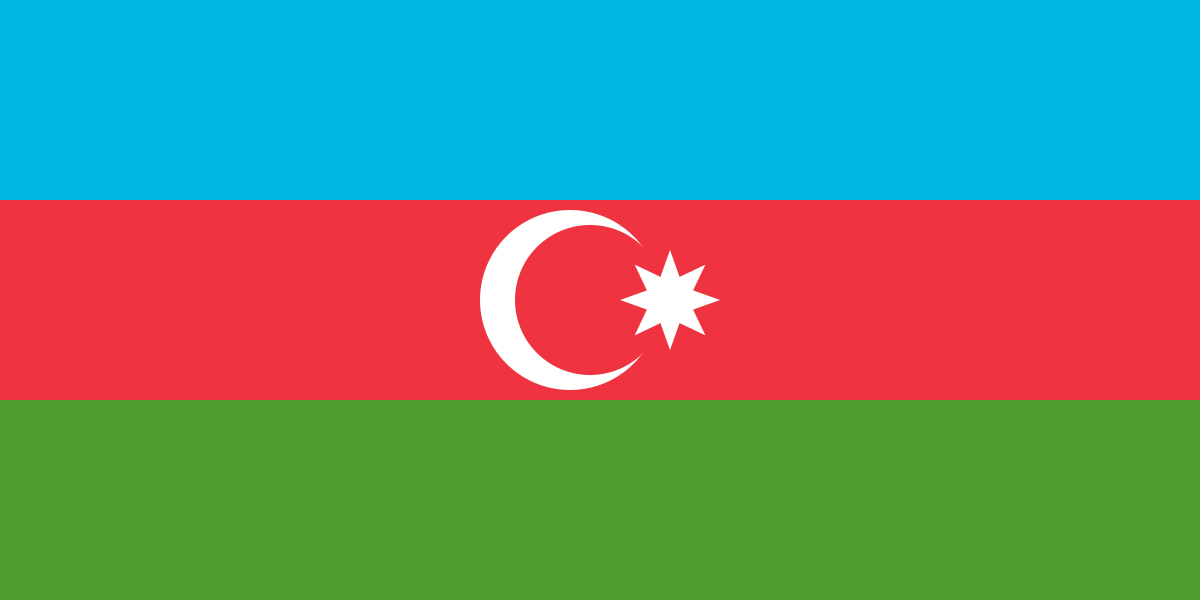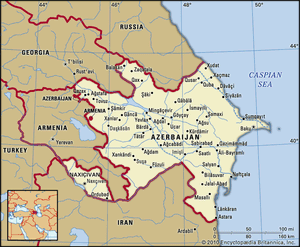
Azerbaijan is located at the crossroads of Eastern Europe and Western Asia in the South Caucasus region. It is bounded by the Caspian Sea to the east, Russia to the north, Georgia to the northwest, Armenia to the west, and Iran to the south. The Nakhchivan Autonomous Republic, an exclave of Azerbaijan, is separated from the main territory by Armenia and borders Iran, Armenia, and Turkey. The nation’s geography is dominated by the Greater Caucasus mountain range in the north, the Lesser Caucasus in the west, and the vast, fertile Kur-Araz Lowland in the central region.
People & Culture
The vast majority of the population consists of ethnic Azerbaijanis (Azeris), alongside smaller minority groups such as Lezgins, Russians, and Talysh. Azerbaijani (Azeri), a Turkic language, is the official language.
Islam is the predominant religion, with Azerbaijan having one of the highest Shia Muslim population percentages in the world, alongside a significant Sunni community, while maintaining a strictly secular state and society. Azerbaijani culture blends Turkic, Caucasian, Persian, and Islamic traditions. Mugam, a traditional form of music featuring complex vocal improvisations and instruments like the tar and kamancha, is a recognized cultural treasure. The national sport is freestyle wrestling, though chess and football are also widely popular. Local cuisine relies heavily on fresh herbs, aromatic spices, and rice, with plov (seasoned rice pilaf) considered the national dish, along with various types of kebab and kutab (stuffed flatbreads).
Nature
Azerbaijan features nine of the world’s eleven climate zones, ranging from subtropical in the Lankaran Lowland to alpine in the high Caucasus peaks.
The country’s eastern coastline borders the Caspian Sea, the world’s largest inland body of water. Azerbaijan is famous for its unique geological features, including holding over half of the world’s mud volcanoes, which erupt with cold mud and gas. The Gobustan State Reserve protects ancient petroglyphs and mud volcano fields. Rich ecosystems in national parks such as Shirvan and Shahdag provide shelter to diverse wildlife, including the Caucasian leopard, gazelles, brown bears, wolves, and numerous migratory bird species.
Government
Azerbaijan is a presidential republic. Executive power is vested in the President, who serves as head of state and holds extensive political authority. The Prime Minister serves as head of government and manages the cabinet. Legislative authority is exercised by the unicameral National Assembly (Milli Majlis).
History
Inhabited since antiquity, the region was historically influenced by the Median and Achaemenid Persian empires, as well as Caucasian Albania. In the 7th century, Arab conquests brought Islam to the region, and subsequent Turkic migrations during the Middle Ages established the Turkic language and cultural identity.
By the 19th century, following the Russo-Persian Wars, the territory was divided between Persia and the Russian Empire, with northern Azerbaijan falling under Russian rule. Following the Russian Revolution, the Azerbaijan Democratic Republic was declared on May 28, 1918, becoming the first secular democratic republic in the Muslim world. However, in 1920, the country was invaded by the Red Army and incorporated into the Soviet Union as the Azerbaijani Soviet Socialist Republic.
Azerbaijan officially declared its independence from the USSR on October 18, 1991. The early years of independence were marked by economic turmoil and the Nagorno-Karabakh conflict with neighboring Armenia, which led to decades of territorial disputes. In recent decades, Azerbaijan has leveraged its vast oil and natural gas reserves in the Caspian Sea to drive rapid economic modernization and infrastructure development.