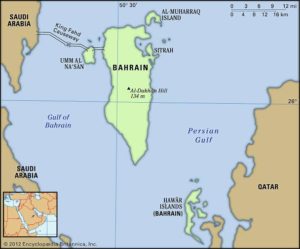
Bahrain is located in the Persian Gulf off the eastern coast of Saudi Arabia and north of Qatar. It is an archipelago nation consisting of 50 natural islands and an additional 33 artificial islands, with Bahrain Island making up the vast majority of the country’s landmass. The terrain is predominantly low-lying, flat, and arid desert plain, rising gently to a central low escarpment known as the Mountain of Smoke (Jabal al-Dukhan), the nation’s highest point at 440 feet (134 meters) above sea level. The country is connected to neighboring Saudi Arabia by the King Fahd Causeway, a 16-mile (25-kilometer) series of bridges and causeways.
People & Culture
The population is a diverse mix of native Bahraini citizens and a large community of expatriates from South Asia, Southeast Asia, and other Arab nations. Arabic is the official language, though English is universally spoken in commercial and administrative settings. Islam is the official religion and the foundation of local legal and cultural customs, with the native population comprising both Shia and Sunni communities. Bahraini culture reflects a deep maritime heritage rooted in centuries of pearl diving and regional trade along Gulf maritime routes. Traditional music formats such as Fidjeri, historically sung by pearl divers, remain an important cultural tradition. The national cuisine features seasoned rice dishes like machboos (spiced meat or fish with rice), muhammar (sweetened rice served with fried fish), fresh Gulf seafood, and traditional pastries accompanied by Arabic coffee (gahwa).
Nature
Bahrain features an arid desert climate characterized by extremely hot, humid summers and mild winters with scant annual rainfall. Despite the harsh desert conditions, the main island historically possessed natural freshwater springs that nurtured lush date palm groves along its northern shores. Offshore, the shallow coastal waters support expansive seagrass beds, coral reefs, and pearl oyster beds. The surrounding waters are home to diverse marine life, including dugongs, sea turtles, dolphins, and various commercial fish species. Notable flora includes the Tree of Life (Shajarat-al-Hayah), a 400-year-old mesquite tree standing isolated in the southern desert without an obvious water source, while protected areas like Hawar Islands provide crucial breeding habitat for colonies of Socotra cormorants and migrating seabirds.
Government
Bahrain is a constitutional monarchy. Executive power is exercised by the King, who serves as the head of state and holds significant constitutional authority, alongside the Prime Minister, who serves as head of government and leads the Cabinet. Legislative authority is vested in the National Assembly, a bicameral parliament consisting of the Council of Representatives, whose members are directly elected by popular vote, and the Consultative Council, whose members are appointed directly by the King.
History
In antiquity, the islands were the heart of the ancient Dilmun civilization, a major regional trading hub connecting Mesopotamia and the Indus Valley from the 3rd millennium BC. The region came under the influence of various powers over the centuries, including the Persian Empires, the Seleucids, and later Islamic caliphates following the arrival of Islam in the 7th century. Portugal captured the islands in 1521, holding them for nearly a century before being expelled by Persian forces. In 1783, the Al Khalifa family established rule over the islands, founding the ruling dynasty that continues today. Bahrain became a British protectorate through a series of treaties in the 19th century. Oil was discovered in 1932—the first such discovery on the Arabian side of the Persian Gulf—paving the way for rapid modern economic development. Bahrain gained full political independence from the United Kingdom on August 15, 1971. In recent decades, the country has diversified its economy into banking, financial services, and tourism while maintaining its position as a central financial hub in the Middle East.