
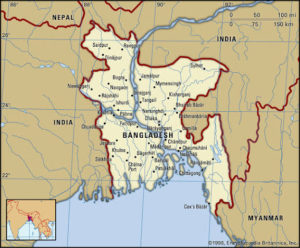
Bangladesh is located in South Asia, occupying the fertile delta of the Ganges, Brahmaputra, and Meghna rivers. It is bordered by India to the west, north, and east, Myanmar to the southeast, and the Bay of Bengal to the south. Its landscape is predominantly low-lying, flat alluvial plain crisscrossed by hundreds of rivers and tributaries, making it one of the most water-rich and ecologically dynamic regions in the world. The far southeastern region along the Chittagong Hill Tracts features rolling hills and mountain ranges along the border with Myanmar.
People & Culture
The vast majority of the population consists of ethnic Bengalis, alongside smaller indigenous ethnic groups in the Chittagong Hill Tracts and northern border regions. Bengali (Bangla) is the official language, written in its own script and celebrated for its rich literary tradition, including the works of Nobel laureate Rabindranath Tagore. Islam is the predominant religion practiced by the majority of the population, alongside significant Hindu, Buddhist, and Christian minorities. Bangladeshi culture is deeply connected to music, poetry, and folk arts, such as Baul music, Nakshi Kantha (embroidered quilts), and festive celebrations like Pohela Boishakh (Bengali New Year). Local cuisine centers on rice, fish, and lentils, with famous regional dishes including hilsa fish curry, biryani, and a vast variety of milk-based sweets like rasgulla and mishti doi.
Nature
Bangladesh experiences a tropical monsoon climate characterized by high temperatures, heavy seasonal rainfall, and high humidity, making the soil exceptionally fertile while leaving the country vulnerable to annual flooding and cyclones. The nation is home to the Sundarbans, the world’s largest mangrove forest, situated along the coastal delta. This UNESCO World Heritage site provides crucial protection against storm surges and serves as one of the last major habitats for the endangered Royal Bengal tiger. The country’s varied ecosystems support diverse wildlife, including Asian elephants, saltwater crocodiles, Ganges river dolphins, and hundreds of species of migratory and resident birds. The coast also features Cox’s Bazar, renowned as one of the longest continuous natural sand beaches in the world.
Government
Bangladesh is a unitary parliamentary republic. Executive authority is led by the Prime Minister, who serves as the head of government and manages political policy, while the President serves as the head of state in a largely ceremonial role. Legislative power is vested in a unicameral parliament known as the Jatiya Sangsad (National Parliament), whose members are elected directly by popular vote.
History
The region has an ancient history, having been part of major historical empires such as the Maurya, Gupta, and Pala empires, followed by centuries of Muslim rule under the Bengal Sultanate and the Mughal Empire, during which Bengal became a thriving center of global textile trade. In the 18th century, the region fell under British colonial control, eventually becoming part of the British Raj. Upon the partition of British India in 1947, the region became East Pakistan, geographically separated from West Pakistan by more than 1,000 miles of Indian territory. Tensions grew between the two regions over political representation, economic disparities, and attempts to suppress the Bengali language and culture. Following the Bengali Language Movement and escalating political conflict, the Bangladesh Liberation War broke out in 1971. With the support of India, Bangladeshi freedom fighters (Mukti Bahini) defeated the Pakistani military, leading to the official establishment of the independent People’s Republic of Bangladesh on December 16, 1971. In the decades since, Bangladesh has made significant strides in economic growth, social development, and human indicators, becoming a global hub for garment manufacturing.




