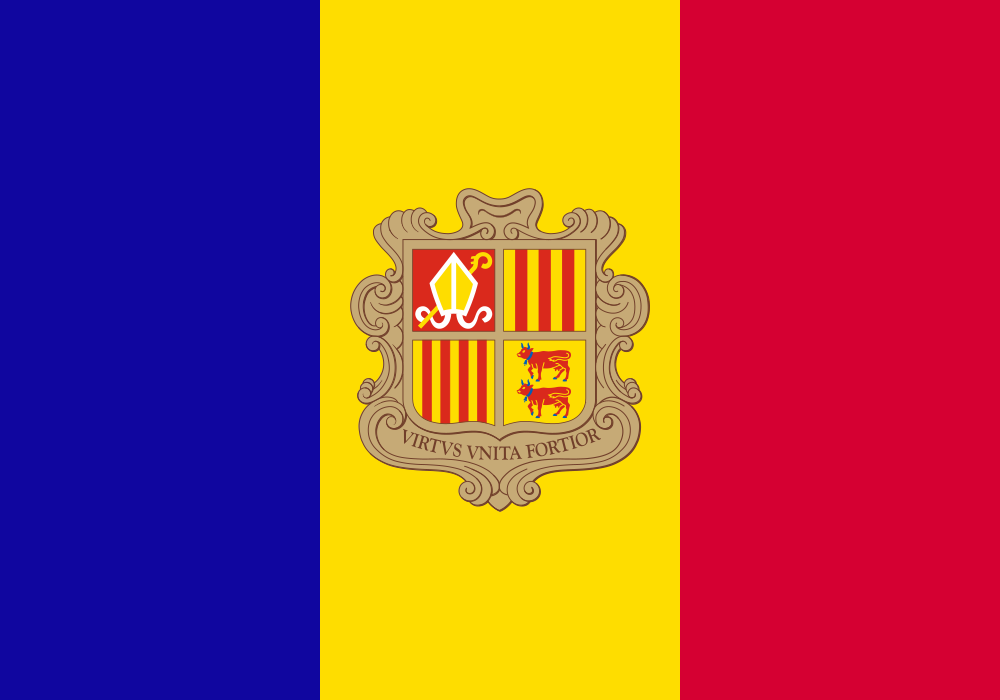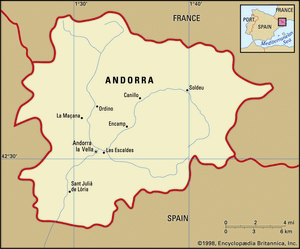
Andorra is located in Southwestern Europe in the eastern Pyrenees mountains, landlocked between France to the north and Spain to the south. It is one of the smallest sovereign states in Europe, covering an area of just under 180 square miles (468 square kilometers). The country consists almost entirely of steep mountains, narrow valleys, and high-altitude alpine landscapes, with an average elevation of nearly 6,600 feet (2,000 meters) above sea level.
People & Culture
The population is primarily composed of ethnic Andorrans, alongside significant groups of Spanish, Portuguese, and French residents. Catalan is the official language, making Andorra the only country in the world where Catalan holds this sole status, though Spanish, French, and Portuguese are also widely spoken.
The culture is deeply rooted in Catalan traditions and mountain heritage. Roman Catholicism is the predominant religion. Local cuisine reflects high-altitude mountain flavors combined with Catalan and French influences, featured in traditional dishes such as escudella (a hearty meat stew) and trinxat (a dish made of potatoes, cabbage, and pork).
Nature
Andorra’s mountain environment experiences cold, snowy winters—making it a prominent European destination for skiing—and mild, dry summers.
Flora & Fauna: The slopes are covered with pine and fir forests, alpine meadows, and species such as chamois (izard), marmots, golden eagles, and the bearded vulture.
Protected Areas: The Madriu-Perafita-Claror Valley, a glacial valley that covers about 9 percent of Andorra’s total land area, is designated as a UNESCO World Heritage site due to its preserved cultural and natural landscape.
Government
Andorra is a parliamentary co-principality with a unique governance system. Its two co-princes serve jointly as the heads of state: the Catholic Bishop of Urgell (from Catalonia, Spain) and the President of France. Executive power is exercised by the Head of Government (Prime Minister). Legislative power rests with the General Council (Consell General), a unicameral parliament. Though not an official member of the European Union, Andorra uses the euro as its official currency.
History
According to tradition, Charlemagne granted a charter to the Andorran people in the 9th century in exchange for their support in fighting the Moors.
The Paréages (1278): A feud between the Bishop of Urgell and the French Count of Foix over control of Andorra was settled by signing a feudal contract called a Paréage. This established joint sovereignty over the territory between the bishop and the count (whose rights were later passed to the French crown and eventually the French president).
20th Century: Andorra remained relatively isolated from major European conflicts during World War I and World War II, preserving its neutral status.
1993 Constitution: Andorra modernized its political system by adopting its first written constitution in 1993. This established Andorra as an independent, sovereign democratic state, joining the United Nations the same year while retaining the symbolic roles of the two co-princes.