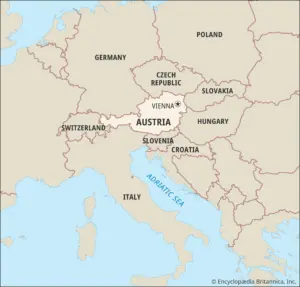
Austria is located in Central Asia with… wait, no—Austria is located in Central Europe, landlocked by Germany and the Czech Republic to the north, Slovakia and Hungary to the east, Slovenia and Italy to the south, and Switzerland and Liechtenstein to the west. Its topography is dominated by the majestic Eastern Alps, which cover roughly 62 percent of the nation’s total surface area, while the fertile Danube River basin defines the northern and eastern regions.
People & Culture
The vast majority of the population is ethnic Austrian, and the official language is German, spoken in various Austro-Bavarian dialects alongside standard German. Austrian culture is world-renowned for its extraordinary classical music heritage, having been home to legendary composers such as Wolfgang Amadeus Mozart, Ludwig van Beethoven, Franz Schubert, and Johann Strauss. Religion is predominantly Roman Catholic, though the nation maintains freedom of worship. Coffeehouse culture (Kaffeehauskultur) is a cherished social tradition, particularly in Vienna, where people gather to enjoy espresso drinks alongside famous pastries like Sachertorte and Apfelstrudel. Other signature culinary dishes include Wiener Schnitzel (breaded veal cutlet) and Tafelspitz (boiled beef served with horseradish and apples).
Nature
Austria experiences a temperate Central European climate featuring cold, snowy winters in the alpine regions and mild to warm summers in the lowlands. The landscape is defined by dramatic mountain peaks, dense alpine forests, deep valleys, and pristine glacial lakes such as Lake Constance and Lake Neusiedl. Wildlife across the Alps includes the Alpine ibex, chamois, marmots, golden eagles, and a small population of brown bears in protected national parks like Hohe Tauern National Park, which contains the Grossglockner, Austria’s highest mountain at 12,461 feet (3,798 meters).
Government
Austria is a federal parliamentary representative democratic republic. Executive authority is led by the Federal Chancellor, who serves as the head of government and manages political policy, while the directly elected Federal President serves as the head of state with largely ceremonial duties. Legislative authority rests in the bicameral Parliament, which consists of the Nationalrat (National Council) and the Bundesrat (Federal Council). The country is administratively structured into nine federal states (Bundesländer).
History
Inhabited since ancient times by Celtic tribes and later annexed by the Roman Empire, the territory became a core mark of the Holy Roman Empire during the Middle Ages. The House of Habsburg rose to power in the late 13th century and established a dynasty that would rule Austria for over six centuries, expanding its influence across Europe. Following the collapse of the Holy Roman Empire, the Austrian Empire was established, which later transformed into the dual monarchy of the Austro-Hungarian Empire in 1867. The assassination of Archduke Franz Ferdinand in 1914 triggered World War I, leading to the empire’s defeat and collapse in 1918, after which the First Austrian Republic was declared. Austria was annexed into Nazi Germany during the Anschluss in 1938 and subsequently occupied by Allied forces following World War II until 1955, when the nation regained full independence after signing the Austrian State Treaty and declaring its perpetual neutrality. Austria joined the European Union in 1995 and adopted the euro as its currency, establishing itself as a modern, prosperous nation.