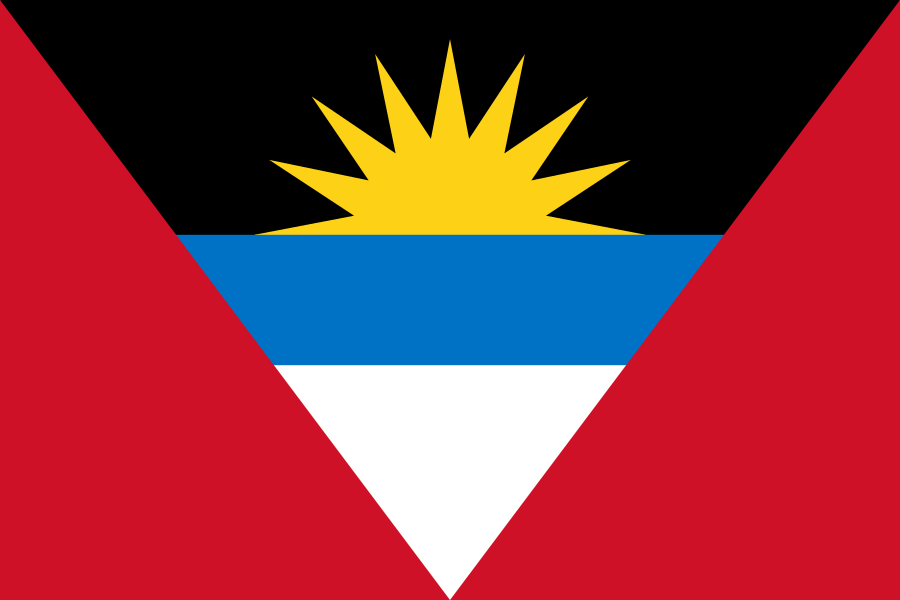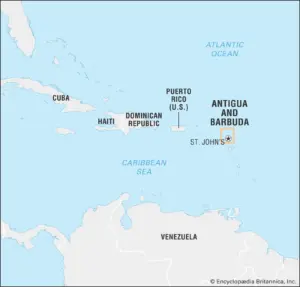
Antigua and Barbuda is located in the eastern Caribbean Sea at the southern end of the Leeward Islands chain in the Lesser Antilles. The country consists primarily of two major inhabited islands, Antigua and Barbuda, along with several smaller uninhabited islands, most notably the rocky island of Redonda. The geography of Antigua is characterized by low-lying terrain with rolling limestone and volcanic hills, with Boggy Peak standing as its highest point. Barbuda, on the other hand, is a flat coral atoll featuring expansive coastal lagoons. The climate is tropical maritime, tempered by constant trade winds from the northeast, resulting in warm temperatures year-round with moderate and irregular rainfall that frequently leads to periods of drought.
People & Culture
The vast majority of the population is of African descent, tracing back to the transatlantic slave trade during the colonial era when ancestors were brought to work on sugarcane plantations. English is the official language used in government, education, and media, while Antiguan Creole—an English-based creole with West African linguistic influences—is widely spoken in daily life. Religion plays a central role in society, with Protestant Christianity being predominant through Anglican, Moravian, and Adventist congregations. The culture is a vibrant mix of Caribbean traditions, African roots, and inherited British customs. Music is a cornerstone of social life, featuring genres such as calypso, soca, and steelpan, which reach their peak during the annual Antigua Carnival each summer. Cricket is the national sport, inspiring deep passion across the nation and producing legendary international players. Local cuisine emphasizes fresh seafood, fish, and root vegetables, with the national dish being fungie—a cornmeal and okra dish similar to polenta—typically served alongside a rich vegetable and meat stew called pepperpot.
Nature
Despite its compact land area, the archipelago’s natural landscape is defined by impressive coastal and marine diversity. Antigua is world-famous for its 365 white and pink sand beaches—one for every day of the year—sheltered by coral reefs and crystal-clear bays. The shores are lined with extensive mangrove ecosystems that serve as nurseries for marine life and protect the coastline from erosion. Barbuda preserves a remarkably pristine natural state, hosting the Codrington Lagoon National Park, a internationally recognized wetland habitat that protects one of the world’s largest breeding colonies of magnificent frigatebirds. Territorial waters are rich in marine species, providing habitats for hawksbill and green sea turtles, stingrays, spiny lobsters, and tropical coral reefs. Terrestrial fauna includes seabirds, various lizard species, and an introduced wild population of fallow deer on Barbuda.
Government
Antigua and Barbuda is an independent parliamentary constitutional monarchy within the Commonwealth of Nations. The British monarch is recognized as the ceremonial head of state and is represented locally by an appointed Governor-General. Executive power rests with the Prime Minister, who serves as the head of government and leads the majority political party in the legislature. Legislative authority is exercised by a bicameral Parliament consisting of an elected House of Representatives, chosen by popular vote every five years, and an appointed Senate, selected by the Governor-General on the advice of the Prime Minister and the leader of the opposition. The judicial system is independent, with ultimate appellate jurisdiction held by the Eastern Caribbean Supreme Court. Since independence, the country has maintained a stable democratic system with peaceful transfers of power.
History
The islands were originally inhabited by semi-nomadic indigenous peoples, including the Ciboney, followed by Arawak and Carib communities that navigated the Antillean arc. Christopher Columbus sighted the islands in 1493 during his second voyage to the Americas, naming the main island after Santa María de la Antigua, a shrine in Seville, Spain. Following unsuccessful settlement attempts by the Spanish and French, the British successfully colonized Antigua in 1632 and Barbuda in 1685. Under British rule, the territory transformed into a lucrative sugarcane monoculture economy reliant on the labor of thousands of enslaved Africans. Due to its strategic location and sheltered harbors, such as Nelson’s Dockyard, Antigua became the primary British naval base in the Caribbean. Slavery was legally abolished throughout the British Empire in 1834, though the emancipated population continued to face harsh economic conditions under the control of plantation owners. During the first half of the 20th century, labor unions and political movements emerged, driving demands for workers’ rights, universal suffrage, and political autonomy. The nation achieved full internal self-government in 1967 and gained full independence from the United Kingdom on November 1, 1981. In subsequent decades, the national economy successfully transitioned from sugar agriculture into an international hub for luxury tourism, financial services, and recreational sailing.