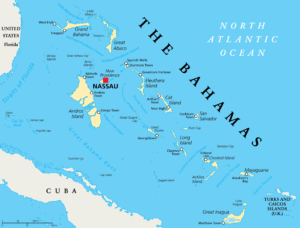
The Bahamas is located in the Lucayan Archipelago in the Atlantic Ocean, situated north of Cuba and Hispaniola and southeast of the U.S. state of Florida. The country is an archipelago consisting of more than 700 islands, cays, and islets spread across roughly 100,000 square miles of ocean. The islands feature a remarkably flat topography, with Mount Alvernia on Cat Island standing as the highest point at just 206 feet (63 meters) above sea level. The geography is characterized by extensive coral reefs, shallow turquoise ocean banks, and white and pink sand beaches.
People & Culture
The vast majority of the population is of African descent, originating from enslaved Africans brought to the islands during the British colonial era. English is the official language, while Bahamian Creole, an English-based creole with West African influences, is widely spoken in daily informal life. Religion plays a fundamental role in Bahamian society, with Protestant Christianity being predominant, particularly Baptist, Anglican, and Pentecostal denominations. Bahamian culture is a vibrant blend of African heritage, British colonial traditions, and neighboring Caribbean influences. The most famous cultural celebration is Junkanoo, a lively street parade held on Boxing Day and New Year’s Day featuring colorful costumes, dancing, and music made with cowbells, drums, and brass instruments. Local cuisine relies heavily on seafood, with conch—a large marine mollusk—serving as the national ingredient, served in dishes such as conch salad, conch fritters, and conch chowder, along with rock lobster, peas and rice, and guava duff.
Nature
The country experiences a tropical to subtropical climate moderated by the warm waters of the Gulf Stream, resulting in warm weather year-round, though the region is vulnerable to seasonal hurricanes. The surrounding marine waters are among the clearest in the world, hosting expansive coral reef systems like the Andros Barrier Reef, the third-largest living barrier reef in the world. The islands feature diverse coastal ecosystems, including extensive mangrove wetlands, blue holes (underwater vertical caves), and protected national parks such as the Inagua National Park, home to the world’s largest breeding colony of West Indian flamingos. Marine life includes reef sharks, sea turtles, stingrays, and wild pigs on Big Major Cay.
Government
The Bahamas is an independent constitutional monarchy within the Commonwealth of Nations. The British monarch is recognized as the head of state and is represented locally by a Governor-General. Executive authority rests with the Prime Minister, who serves as head of government and leads the majority party in parliament. Legislative power is vested in a bicameral Parliament consisting of an elected House of Assembly and an appointed Senate.
History
The islands were originally inhabited by the Lucayan people, a branch of the Taíno, who lived throughout the archipelago for centuries. Christopher Columbus made his first landfall in the Americas in the Bahamas in 1492, landing on the island of Guanahani, which he renamed San Salvador. The native Lucayan population was subsequently depopulated through enslavement and disease brought by Spanish colonizers. During the 17th century, English Puritans known as the Eleutheran Adventurers established permanent European settlements, and the islands later became a notorious haven for pirates during the Golden Age of Piracy before becoming a formal British Crown Colony in 1718. Slavery was abolished in 1834, and the country steadily progressed toward self-governance in the 20th century. The Bahamas gained full political independence from the United Kingdom on July 10, 1973, subsequently developing a modern economy driven heavily by international tourism and offshore financial services.