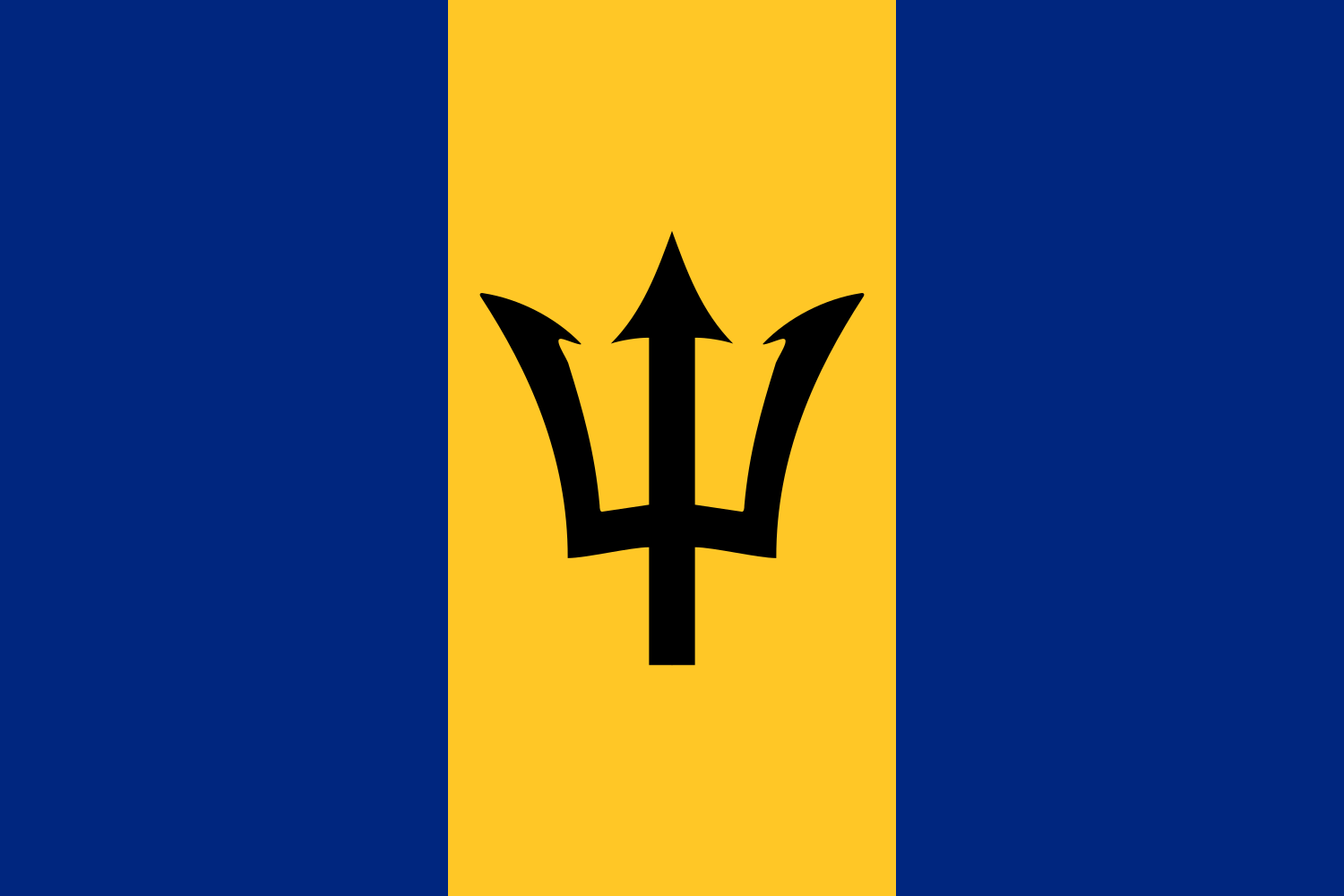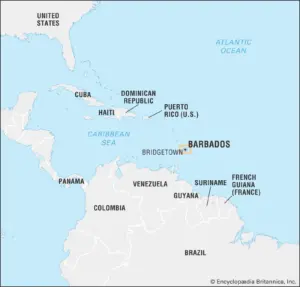
Barbados is located in the eastern Caribbean Sea, situated as the easternmost island in the Lesser Antilles chain. Unlike many of its volcanic neighbor islands, Barbados is a relatively flat coral limestone island that was geologically pushed up out of the ocean floor. The terrain consists of gentle lowland plains and rolling hills in the interior, rising to its highest elevation at Mount Hillaby, which stands at 1,115 feet (340 meters) above sea level. The country is completely surrounded by the Atlantic Ocean, with calm, turquoise waters lining its western coast and rougher Atlantic surf shaping its eastern shore.
People & Culture
The vast majority of the population is of African descent, tracing back to the transatlantic slave trade during British colonial rule, alongside smaller groups of European and Asian descent. English is the official language used in government, education, and media, while Bajan—an English-based creole featuring West African linguistic influences—is spoken in daily informal life. Religion is an essential part of society, with Christianity being predominant, particularly through Anglican, Pentecostal, and Methodist denominations. Barbadian culture, often referred to as Bajan, is a unique blend of West African roots and strong British traditions. The island’s most famous cultural event is the Crop Over festival, a traditional harvest celebration dating back to the 18th century that culminates in a grand carnival parade featuring colorful costumes and calypso music. Cricket is a national obsession, and the island has produced some of the world’s most celebrated players. The local cuisine centers on fresh seafood, with flying fish serving as a national icon, commonly served alongside cou-cou (a dish made of cornmeal and okra), as well as Bajan fish cakes and roasted pork.
Nature
Barbados experiences a tropical climate moderated by constant trade winds, resulting in warm, pleasant weather year-round with distinct wet and dry seasons. The island is surrounded by extensive coral reefs that protect its pristine white and pink sand beaches. While much of the island’s interior was historically cleared for agriculture, remnants of native tropical forests survive in gullies and protected reserves. Harrison’s Cave is a famous natural underground cave system featuring living stalactites, stalagmites, and subterranean streams. Marine ecosystems host diverse species including hawksbill and green sea turtles, flying fish, and colorful reef fish, while terrestrial wildlife includes the Barbados green monkey, whistling frogs, and various tropical bird species.
Government
Barbados is a parliamentary republic. Executive power is led by the Prime Minister, who serves as the head of government and leads the majority political party in parliament. The President serves as the head of state, holding primarily ceremonial duties. Legislative authority is vested in a bicameral Parliament, consisting of an elected House of Assembly and an appointed Senate. The country was formerly a constitutional monarchy recognizing the British monarch as head of state until officially transitioning to a republic on November 30, 2021.
History
The island was originally inhabited by indigenous Amerindian populations, including the Arawak and Carib peoples, before becoming uninhabited prior to European arrival. English settlers arrived in 1627 and established a permanent settlement at Jamestown (modern-day Holetown), claiming the island for the British Crown. Barbados quickly developed into a wealthy colonial economy centered on sugarcane cultivation, becoming one of the primary centers of the transatlantic slave trade and relying on the labor of tens of thousands of enslaved Africans. Slavery was legally abolished throughout the British Empire in 1834, though former slaves remained economically dependent on plantation owners for generations. During the 20th century, trade union leaders and social reformers pushed for universal adult suffrage and political autonomy. Barbados achieved full political independence from the United Kingdom on November 30, 1966. In the decades following independence, the country transformed its economy from sugar production into a prosperous, stable nation supported by international tourism, offshore banking, and light manufacturing.